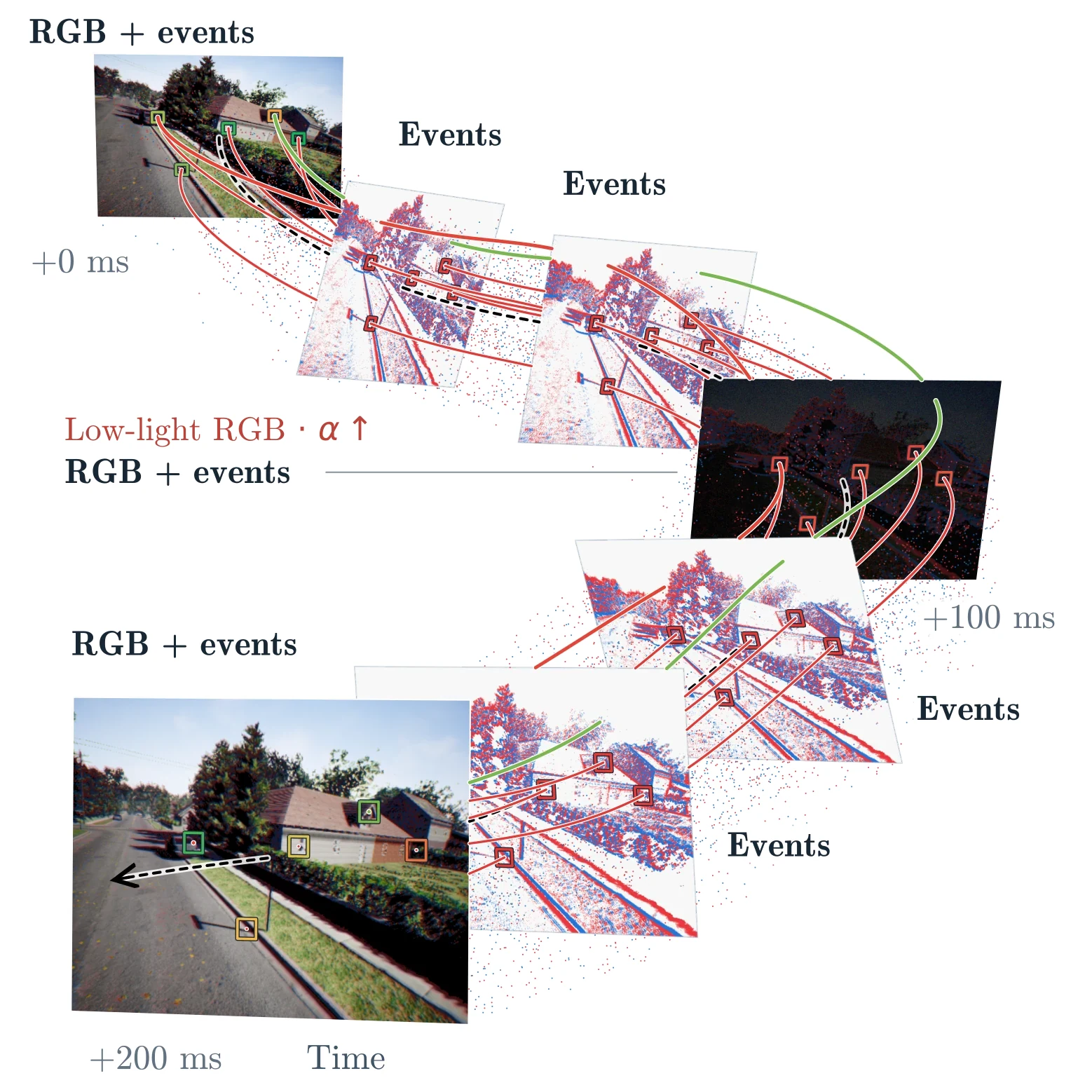
UZH researchers developed DAPEVO to estimate camera motion from conventional images and asynchronous event-camera measurements. It tracks corresponding patches in both inputs separately, then uses a learned gate to combine their evidence before refining the motion estimate. After initialization using both images and events, event-only observations let tracking continue between sparse or unavailable conventional frames.
On the UZH-FPV benchmark, retaining only one in six conventional frames increased DAPEVO's mean absolute trajectory error from 1.00 to 1.36 metres. In the same experiment, errors for DPVO and RAMP-VO rose by factors of 3.7 and 3.1 respectively. These are benchmark results from a research preprint, not a deployed navigation system.