ETH drone keeps flying after collisions
ETH Zurich’s FlexiQuad uses a flexible ring-shaped frame to survive collisions at around 25 km/h while retaining agile flight.

ETH Zurich’s FlexiQuad uses a flexible ring-shaped frame to survive collisions at around 25 km/h while retaining agile flight.
ANYbotics has begun delivering its explosion-protected inspection robot to customers including Equinor and DSM-Firmenich.
ETH-linked startup Odin Robotics demonstrates robot arms loading a CNC mill and packing containers from a moving conveyor, as part of its launch in Y Combinator's Fall 2026 batch.
Enact raises USD 30 million to develop robots that sense force and touch through their own actuators.

ETH Zurich researchers jointly designed living muscle tissue and soft scaffolds to build small robots that jump, walk, swim and grasp, with up to eleven times the movement of comparable earlier actuators.

ETH Zurich researchers taught an ANYmal robot to scan, plan and solve a giant Rubik’s cube autonomously, using its feet to hold and turn the layers.
Disney Research and ETH Zurich demonstrated a locomotion system that takes a movement-style example and a joystick velocity command as separate inputs. A style encoder conditions an autoregressive diffusion model, which generates reference motions for a reinforcement-learning controller to follow.
The team demonstrated real-time control and continuous style changes in a simulated humanoid and on a physical robot. The method learns from unstructured motion recordings without explicit style labels and can reproduce styles not seen during training.
MicroAGI founder Bercan Kilic reports USD 100 million in annual recurring revenue six months after launching Shift. The robotics company has a research hub in Zurich.
ANYbotics has announced Shift, a software platform connecting robot inspection missions, equipment records and maintenance work orders. The Zurich company's expanded successor to Data Navigator combines plant mapping, fleet scheduling and inspection analysis, so readings remain linked to the equipment being monitored.
Teams can schedule multi-robot missions and examine thermal, acoustic, visual and gas readings. Its API works in both directions: maintenance systems can request inspections, while confirmed findings can become work orders in tools such as SAP and IBM Maximo. Existing customers are due to migrate through a platform update; third-party robot fleet control is planned for a later release.
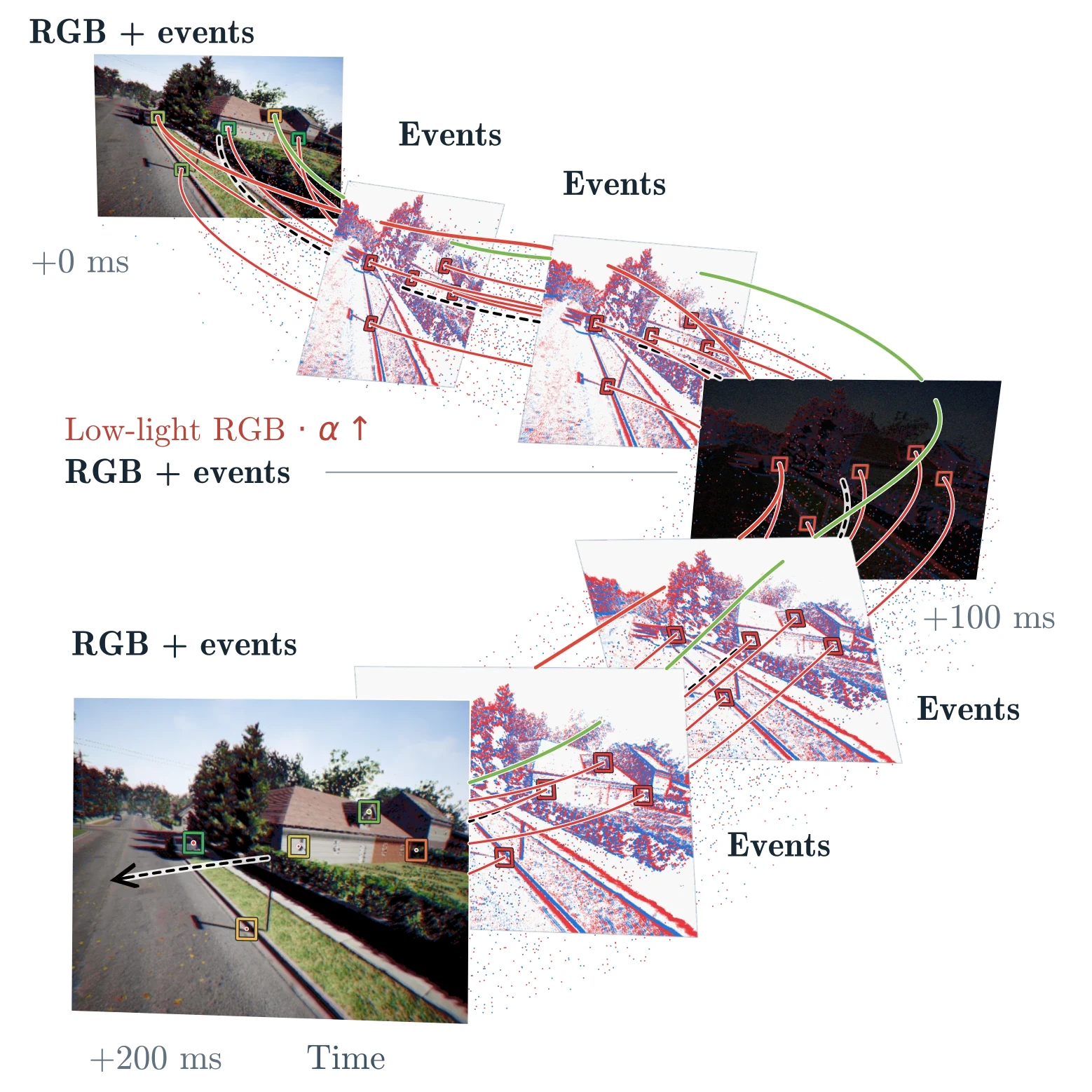
UZH researchers developed DAPEVO to estimate camera motion from conventional images and asynchronous event-camera measurements. It tracks corresponding patches in both inputs separately, then uses a learned gate to combine their evidence before refining the motion estimate. After initialization using both images and events, event-only observations let tracking continue between sparse or unavailable conventional frames.
On the UZH-FPV benchmark, retaining only one in six conventional frames increased DAPEVO's mean absolute trajectory error from 1.00 to 1.36 metres. In the same experiment, errors for DPVO and RAMP-VO rose by factors of 3.7 and 3.1 respectively. These are benchmark results from a research preprint, not a deployed navigation system.
Mimic and BMW researchers tested FLUX-mimic on automotive tasks including component assembly, cable routing and sorting deformable foam parts into trays. The model combines a pretrained FLUX 3 video backbone with an action model that generates robot movements, without needing to generate a complete video during operation.
In the foam-part sorting experiment, a Franka robot succeeded in 95% of 40 trials after eight hours of action-labelled demonstrations. That figure excludes earlier backbone pretraining: the project collected nearly 296 hours of industrial recordings across 31 tasks, alongside the backbone's broader training data. The results demonstrate controlled research tasks with separately trained robot policies, not general-purpose factory autonomy.
Researchers at ETH Zurich's Soft Robotics Lab trained a robotic hand to crawl on its fingers, recover after falls and manipulate objects while supporting its own weight. The 818-gram platform combines an off-the-shelf, five-fingered hand with onboard power and computing. Policies trained through reinforcement learning in simulation enabled untethered crawling across 14 indoor and outdoor surfaces.
Separate policies control different skills rather than one general-purpose controller. Hardware trials achieved 21 successful recoveries in 25 attempts and 29 correct keyboard commands in 32 attempts. Keyboard demonstrations began with manual alignment and followed operator-issued commands; pushing a cube towards a target required overhead visual feedback. The work is presented as a research preprint.
Gravis Robotics announced a USD 200 million Series A investment from SoftBank to expand autonomous construction machinery internationally. The ETH Zurich spin-off develops retrofit controls for existing heavy-equipment fleets rather than requiring contractors to replace their machines.
Its Gravis Rack combines the company's control software with a retrofit kit installed on excavators from multiple manufacturers. Operators can use in-cab 3D guidance and hazard detection or supervise machines operating autonomously. Gravis says systems were already deployed on four continents at the announcement; the new funding is intended to scale that rollout.

Exclaim Robotics raised USD 4.95 million in pre-seed funding backed by Founderful to develop robots for AI data-centre maintenance. The Zurich company is targeting physical tasks that software cannot perform, including replacing optical modules, cabling and drives in server racks. Its investor points to the move toward 800V DC rack infrastructure as a reason to automate work close to live electrical equipment.
The company is developing manipulation skills for tightly packed cables, delicate optical connectors and drives that must be aligned precisely. Its planned autonomy combines those task-specific skills with the ability to assess the surrounding environment and approach a maintenance job. When confidence is low, the robot is designed to request teleoperation support. Exclaim says automating routine rack maintenance could reduce the need for staff inside server halls; it was recruiting in Zurich when the funding was announced.

SUIND has raised INR 205 million in a seed round led by Transition VC, with participation from IIMA Ventures. Founded by ETH Zurich alumni, the company now operates primarily from Bengaluru and retains a Zurich presence. The financing will expand deployment of its Bumblebee agricultural drone and support development of WASP, an aerial inspection and monitoring platform.
Its flight technology uses computer vision to navigate close to terrain and obstacles where GPS alone is unreliable. Bumblebee is already deployed for crop spraying; WASP extends the approach to other inspection and surveillance tasks. The company plans to strengthen its engineering team and scale manufacturing and commercial deployments, with India remaining its main market.

MicroAGI raised USD 55 million in seed funding led by Hummingbird, with Northzone, LocalGlobe, Village Global and redalpine participating. The Munich-headquartered company, which has a robotics research hub in Zurich, will use the funding to expand its Atlas platform for industrial robot deployment.
Atlas records work inside production facilities, augments the resulting training data in simulation and fine-tunes existing models for plant-specific tasks. Engineers then deploy the systems on robot hardware and feed operational experience back into training. The platform is designed to work across robot manufacturers and model providers.
Glattbrugg-based Nanoflex Robotics has been selected for EUR 12.5 million in blended financing under the European Innovation Council Accelerator. The award comprises a EUR 2.5 million grant and EUR 10 million in equity investment from the EIC Fund; the announcement describes a funding award, not confirmation that all funds have been disbursed.

NEURA Robotics announced a Series C financing with a total size of up to USD 1.4 billion on June 10, 2026. Named backers included Tether, Qualcomm Technologies, Amazon, NVIDIA, Bosch, Schaeffler and the European Investment Bank. The company said the financing would support robot manufacturing, its Neuraverse software platform and real-world robot training facilities.
The German-headquartered company has a direct Zurich connection: in December 2025 it announced a Seefeld development site for its 4NE1 humanoid, while keeping production in Metzingen. The announced financing size is an upper limit, not a disclosed amount already received.

Sony AI reported that its Ace table-tennis robot won matches against seven players with current or recent professional rankings in tests held from February to April 2026. The opponents included Miyuu Kihara and Miu Hirano. This extends the earlier Nature study, in which Ace beat elite players but had not yet outplayed professionals.
The Zurich-linked research team improved control, simulation, hardware and perception, with a single reinforcement-learning policy now handling nine skills. Sony published match-by-match results: the system won at least one match against seven of eight opponents, but lost all three against Ono. Matches followed official competition rules; several early assessments were internal, without external umpires.
ETH Zurich and University of Zurich researchers have combined neural progenitor cells with magnetoelectric nanoparticles to create microrobots that can be guided and stimulated using external magnetic fields. The particles turn magnetic signals into electrical stimulation, encouraging the transplanted cells to develop into nerve cells without implanted electrodes. A microfluidic production system assembles the cell-particle combinations.
In injured zebrafish larvae, the treatment restored nearly normal swimming and exploratory behaviour within three days. Mice with completely severed spinal cords showed substantial improvements in movement over four weeks, alongside neural repair at the injury site. These are preclinical results: long-term particle clearance, suitable stimulation settings and safety must be established before human testing.
