Menu

News

RL

Tags

Robots copy walking styles from motion examples

Disney Research and ETH Zurich demonstrated a locomotion system that takes a movement-style example and a joystick velocity command as separate inputs. A style encoder conditions an autoregressive diffusion model, which generates reference motions for a reinforcement-learning controller to follow.

The team demonstrated real-time control and continuous style changes in a simulated humanoid and on a physical robot. The method learns from unstructured motion recordings without explicit style labels and can reproduce styles not seen during training.
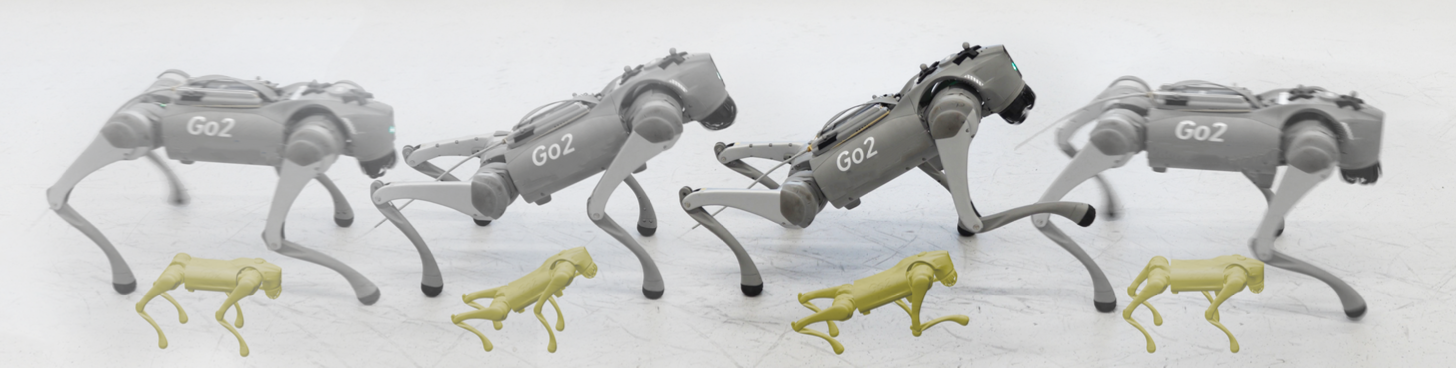
Walk Like This demonstration in simulation and on a physical robot. Video: Disney Research / ETH Zurich.Watch video

A robotic hand walks on its fingers and gets back up after falls

Researchers at ETH Zurich's Soft Robotics Lab trained a robotic hand to crawl on its fingers, recover after falls and manipulate objects while supporting its own weight. The 818-gram platform combines an off-the-shelf, five-fingered hand with onboard power and computing. Policies trained through reinforcement learning in simulation enabled untethered crawling across 14 indoor and outdoor surfaces.

Separate policies control different skills rather than one general-purpose controller. Hardware trials achieved 21 successful recoveries in 25 attempts and 29 correct keyboard commands in 32 attempts. Keyboard demonstrations began with manual alignment and followed operator-issued commands; pushing a cube towards a target required overhead visual feedback. The work is presented as a research preprint.

Video: ETH Zurich Soft Robotics Lab

Sony AI's Ace robot beats seven ranked table-tennis professionals

Sony AI reported that its Ace table-tennis robot won matches against seven players with current or recent professional rankings in tests held from February to April 2026. The opponents included Miyuu Kihara and Miu Hirano. This extends the earlier Nature study, in which Ace beat elite players but had not yet outplayed professionals.

The Zurich-linked research team improved control, simulation, hardware and perception, with a single reinforcement-learning policy now handling nine skills. Sony published match-by-match results: the system won at least one match against seven of eight opponents, but lost all three against Ono. Matches followed official competition rules; several early assessments were internal, without external umpires.

Ace match highlights. Video: Sony AI

Disney's ReActor transfers human movements to differently shaped robots

Disney Research has developed ReActor, a method for turning human motion into movements that differently proportioned robots can actually perform. Instead of adapting an animation first and training a robot afterwards, it optimises both the reference movement and the robot's controller together in a physics simulation.

The team demonstrated the method in simulation and on physical hardware, including transferring human movements to a four-legged robot. Using a small set of corresponding body points, it adjusts the motion to the robot's shape while avoiding problems such as sliding feet, self-collisions and impossible poses. The work comes from Disney's Zurich robotics group and was presented at SIGGRAPH 2026.

ReActor motion-retargeting demonstrations. Video: Disney ResearchWatch video

Disney's Kamino simulates closed-loop robots across thousands of GPU environments

Disney Research and NVIDIA researchers in Zurich developed Kamino, a GPU physics solver for robots whose mechanisms contain tightly coupled joints and closed kinematic loops. Built with NVIDIA Warp and integrated into Newton, it can simulate structurally different robots in parallel without first replacing their mechanisms with simplified joint trees.

The researchers demonstrated reinforcement-learning training for DR Legs, a biped containing six nested kinematic loops, using 4,096 parallel environments on one GPU to produce a feasible walking policy. The solver is in beta and targets large simulation batches; dedicated articulated-body solvers remain faster for simple joint trees.

Simulation examples from the Kamino physics solver. Video: Disney Research; these are simulated mechanisms, not footage of physical robots.

Legged robots reach specified poses at set times

Disney Research Studios and ETH Zurich presented RobotKeyframing, a control framework that lets legged robots follow sequences of poses specified at particular times. Instead of prescribing every movement, an operator can provide partial or complete target poses, with the learned controller generating the locomotion needed to reach them. The work was presented at the Conference on Robot Learning.

The system combines a transformer encoder, which accepts a variable number of future targets, with reinforcement learning using multiple critics to handle both continuous movement rewards and sparse target-reaching rewards. In simulation and hardware experiments, robots followed the requested keyframe sequences at the specified times. The researchers reported that anticipating upcoming targets improved performance, while the multi-critic approach reduced the hyperparameter tuning needed compared with a single-critic alternative.

RobotKeyframing research demonstration. Image: Disney Research Studios and ETH Zurich.

Swift autonomous drone beats human racing champions

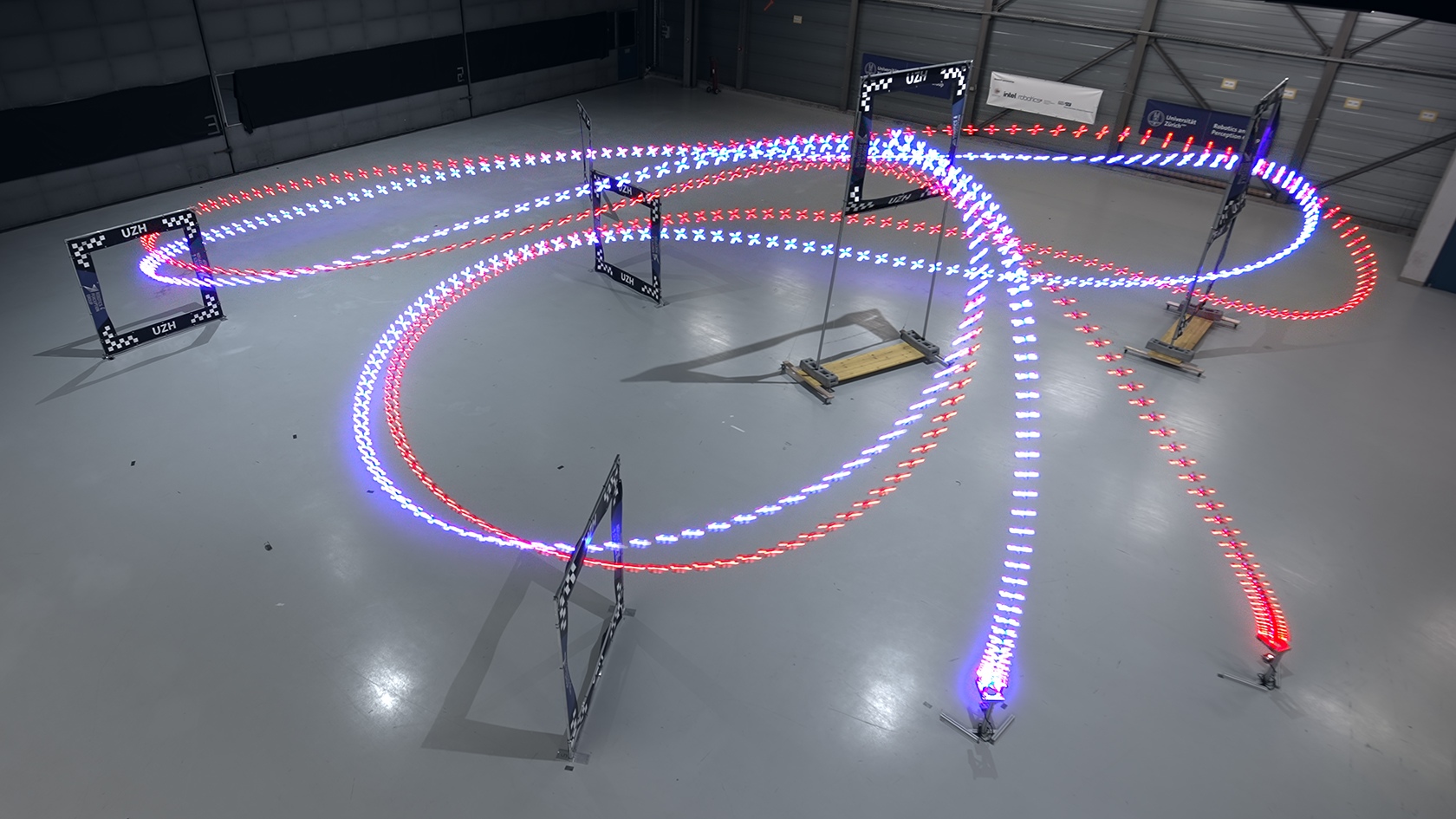
University of Zurich researchers reported that their Swift autonomous drone-racing system defeated world-champion human pilots in head-to-head races. The competition used physical quadcopters on a course at an airfield in Duebendorf. Swift combined an onboard camera and inertial measurements with a control policy trained through reinforcement learning, using simulation and real flight data to prepare for the course.

The system won multiple races against three champions and recorded the fastest lap, half a second ahead of the best human time. The races took place in June 2022; the Nature publication and public announcement followed in August 2023. The result demonstrated high-speed perception and control in a structured physical environment. The researchers also reported limitations when conditions differed from training, including changes in lighting.

Drone-racing trajectories from the Swift experiments; the autonomous system's fastest lap is shown in blue. Image: UZH / Leonard Bauersfeld.

Gran Turismo Sophy AI races world champions

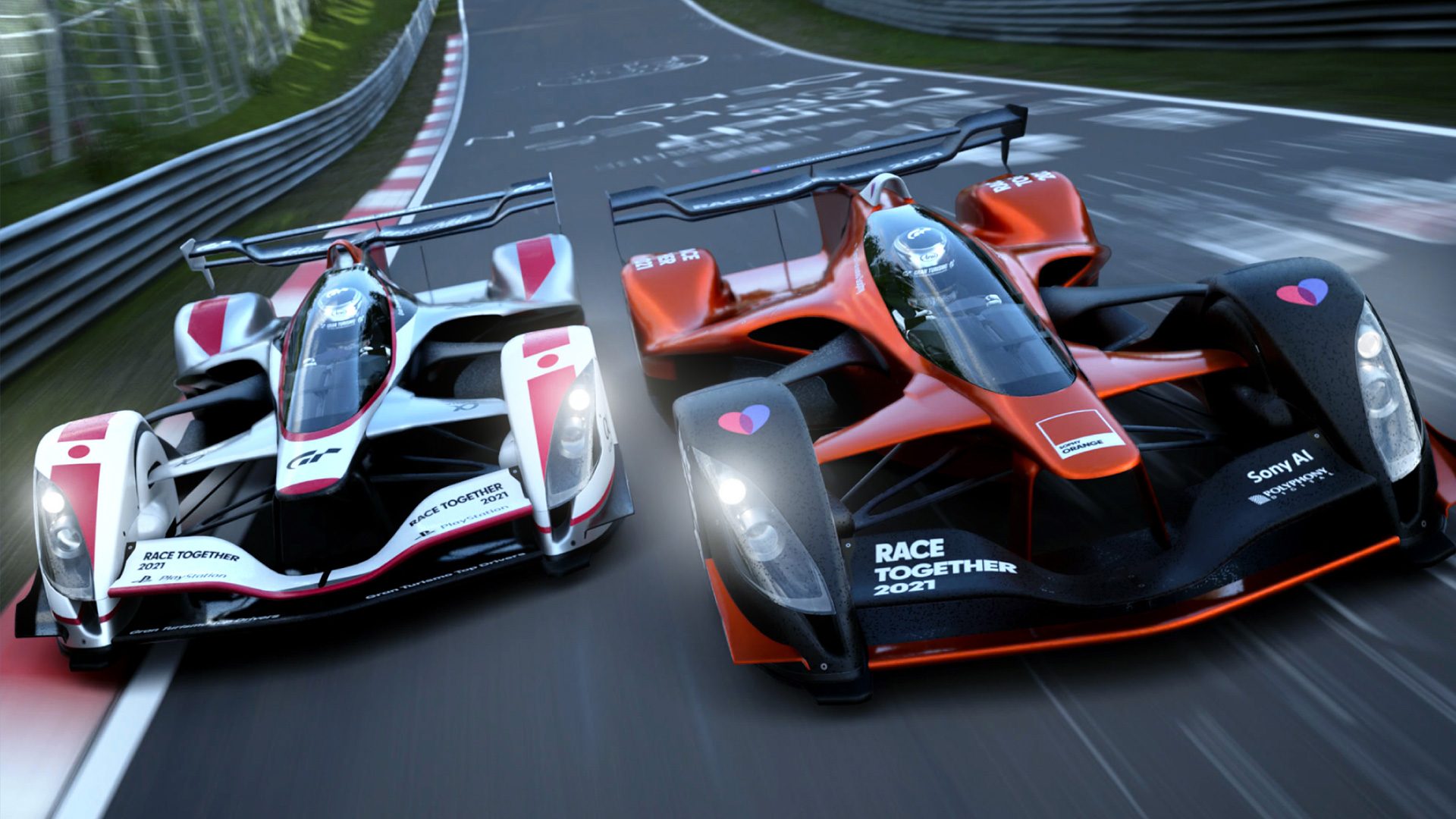
Sony AI unveiled Gran Turismo Sophy, a racing agent trained with deep reinforcement learning to compete against leading human players in Gran Turismo Sport. The research combined vehicle control, overtaking tactics and racing etiquette, including learning to avoid penalties and collisions. Sony AI developed the system with Polyphony Digital and Sony Interactive Entertainment, using large-scale training infrastructure to improve its behaviour through repeated simulated races.

The Nature research followed competitions against champion drivers in the Gran Turismo Sport simulation in 2021. Zurich-based Sony AI researcher Florian Fuchs worked on developing and training Sophy as part of the international team. The February announcement presented the research achievement, covering the agent's training method and competitive performance.

Gran Turismo racing imagery accompanying Sony's Sophy announcement. Image: Sony Interactive Entertainment / Polyphony Digital.

Confirm