Menu

News

Security

Tags

Colt launches Anapaya-based SCION networking across three continents

Colt launched a fully managed SCION networking service across Europe, North America and Asia using Zurich-based Anapaya's technology. Commercial availability follows a two-year proof of concept, including testing with financial-sector organisations. The service lets customers define, audit and enforce the paths their traffic takes, giving them control over routing for sensitive or regulated communications.

Colt offers two configurations: SCION private connects customers to existing private ecosystems and extranets, while SCION Global provides a WAN for an organisation's backbone network. The release describes security and resilience benefits but provides no quantified performance benchmark or service-availability measurements.
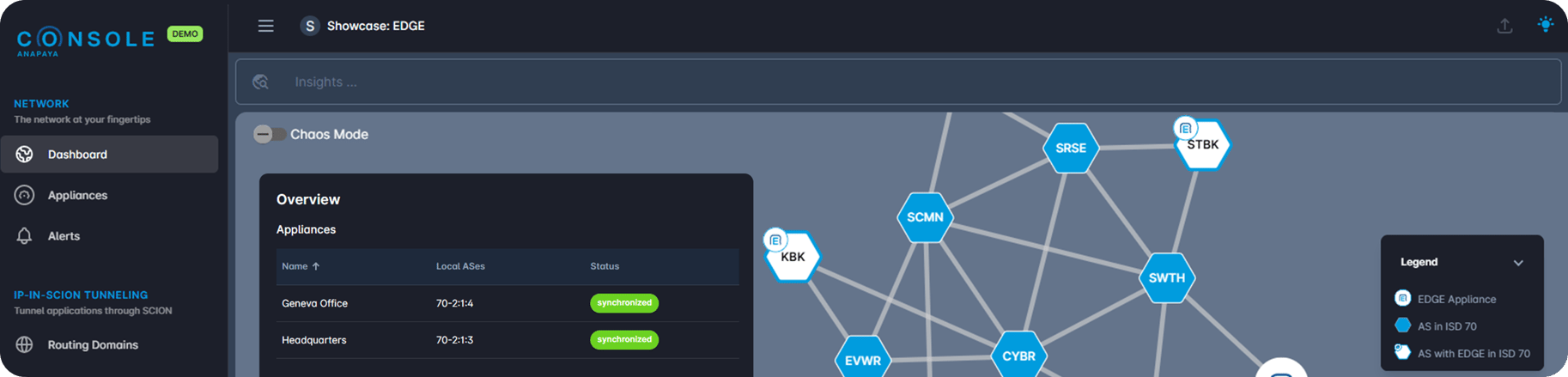

Anapaya Console network-management interface. Image: Anapaya

xorlab raises EUR 5M Series A+

Zurich-based xorlab raised EUR 5 million in a Series A+ led by existing investor Spicehaus Partners, with Grapha Holding, EquityPitcher Ventures and ZKB Start-up Finance also participating. The funding supports European expansion, initially across DACH, Benelux and the Nordic countries.

Its email-security software evaluates messages against an organisation's communication patterns to identify suspicious senders and requests, including phishing and business email compromise without malicious attachments. Customers can run it on their own premises, in a hybrid configuration or in a cloud service with processing in European data centres.

Email-security dashboard. Image: xorlab

SignalFisher raises CHF 12M Series A

SignalFisher raised CHF 12 million in a Series A led by Direttissima Growth Partners, with equal participation from Deutsche Beteiligungs AG. The capital increase gives the investors a minority stake, while the founders retain majority ownership.

The Zurich cybersecurity company will expand internationally, grow its team and develop increasingly autonomous coordination of security tests. Its subscription platform combines automated testing with a network of ethical hackers to continuously assess customers' exposed systems.

SignalFisher leadership team. Photo: SignalFisher

Zurich-developed algorithms become NIST post-quantum standards

NIST published its first three final post-quantum cryptography standards, including two developed by IBM Research scientists in Zurich with external collaborators. ML-KEM, derived from CRYSTALS-Kyber, provides a mechanism for establishing shared secrets. ML-DSA, derived from CRYSTALS-Dilithium, provides digital signatures. Their standardisation turned years of cryptographic research and public evaluation into specifications ready for deployment.

The standards address the risk that future quantum computers could break widely used public-key cryptography. They run on conventional computers and give software developers concrete specifications for migrating communication and authentication systems. NIST's third standard, SLH-DSA, is based on hash-based signatures and was co-developed by a researcher who subsequently joined IBM. The publication provides a common foundation for replacing vulnerable cryptographic components across enterprise and public infrastructure.

Illustration accompanying IBM's post-quantum standards announcement. Image: IBM Research.

Inception attack exposes protected data on affected AMD processors

ETH Zurich researchers disclosed Inception, a speculative-execution attack that can influence a processor's future predictions and expose protected information on affected AMD processors. Daniel Trujillo, Johannes Wikner and Kaveh Razavi investigated how transient execution can train prediction mechanisms, allowing an attacker to steer later speculative behaviour even when existing defences are enabled. The work extended the laboratory's investigation of weaknesses in modern processor prediction systems.

The researchers informed AMD in February 2023 before publishing their findings in August alongside mitigation information. The vulnerability was assigned CVE-2023-20569 and presented at USENIX Security. Unlike a conventional application bug, the weakness involves interactions between processor hardware and the software protections built around it. The disclosure identified a new route to privileged-data leakage and prompted changes to the defences for affected systems.

Hardware used to investigate the Inception vulnerability. Photo: Kaveh Razavi / ETH Zurich.

CYBERA raises USD 5M to scale cybercrime response

CYBERA announced an additional USD 5 million equity investment on 15 September 2022. Converge VC and New North Ventures led the oversubscribed round, with participation from investors including Founder Collective, Serpentine Ventures and CV VC.

The company develops technology to report cybercrime, accelerate responses to fraudulent transactions and support recovery efforts. The financing will help scale its cybercrime-fighting solutions and expand its reach among financial institutions and other organisations.

CYBERA founders Nicola Staub, Sudip Biswas and Claudio Staub. Image: CYBERA.

Skribble raises CHF 10M Series A

Zurich-based Skribble raised CHF 10 million in a Series A co-led by VI Partners and Acton Capital. Earlier backers including btov Partners, Mobiliar, Helvetia Venture Fund and Zurich Cantonal Bank invested again, alongside employees. The financing was the company's third since its foundation in 2018 and was intended to strengthen its position in German-speaking markets and support expansion elsewhere in Europe.

Skribble provides electronic signing workflows for company documents, including qualified electronic signatures. It reported that more than 3,000 companies had digitized signing processes using its service. Shortly before the financing announcement, it added video identification for Swiss qualified signatures with Swisscom and Intrum, supplementing in-person identity checks and reducing a practical barrier to remote signing.

Skribble founders pictured in the funding announcement. Source: Skribble.

Decentriq raises USD 15M Series A

Zurich-based Decentriq announced a USD 15 million Series A led by Eclipse Ventures, with existing investors Atlantic Labs, btov Partners and Paladin Capital Group participating. The financing backed its data clean room platform, which lets organizations collaborate on sensitive information without giving other participants unrestricted access to the underlying records.

The system uses confidential computing to protect data while it is being processed, alongside controls on what analyses participants can run. Decentriq planned to expand the platform's analytical capabilities, including support for Python, R and machine learning, and to grow its commercial and technical teams. The aim was to make joint analysis practical for organizations whose commercial or regulatory obligations prevent them from pooling raw data.

Decentriq co-founder and CEO Maximilian Groth. Photo: Decentriq.

Confirm

Install zurich.tech