Menu

News

CV

Tags

DAPEVO keeps tracking camera motion when video frames drop out

UZH researchers developed DAPEVO to estimate camera motion from conventional images and asynchronous event-camera measurements. It tracks corresponding patches in both inputs separately, then uses a learned gate to combine their evidence before refining the motion estimate. After initialization using both images and events, event-only observations let tracking continue between sparse or unavailable conventional frames.

On the UZH-FPV benchmark, retaining only one in six conventional frames increased DAPEVO's mean absolute trajectory error from 1.00 to 1.36 metres. In the same experiment, errors for DPVO and RAMP-VO rose by factors of 3.7 and 3.1 respectively. These are benchmark results from a research preprint, not a deployed navigation system.
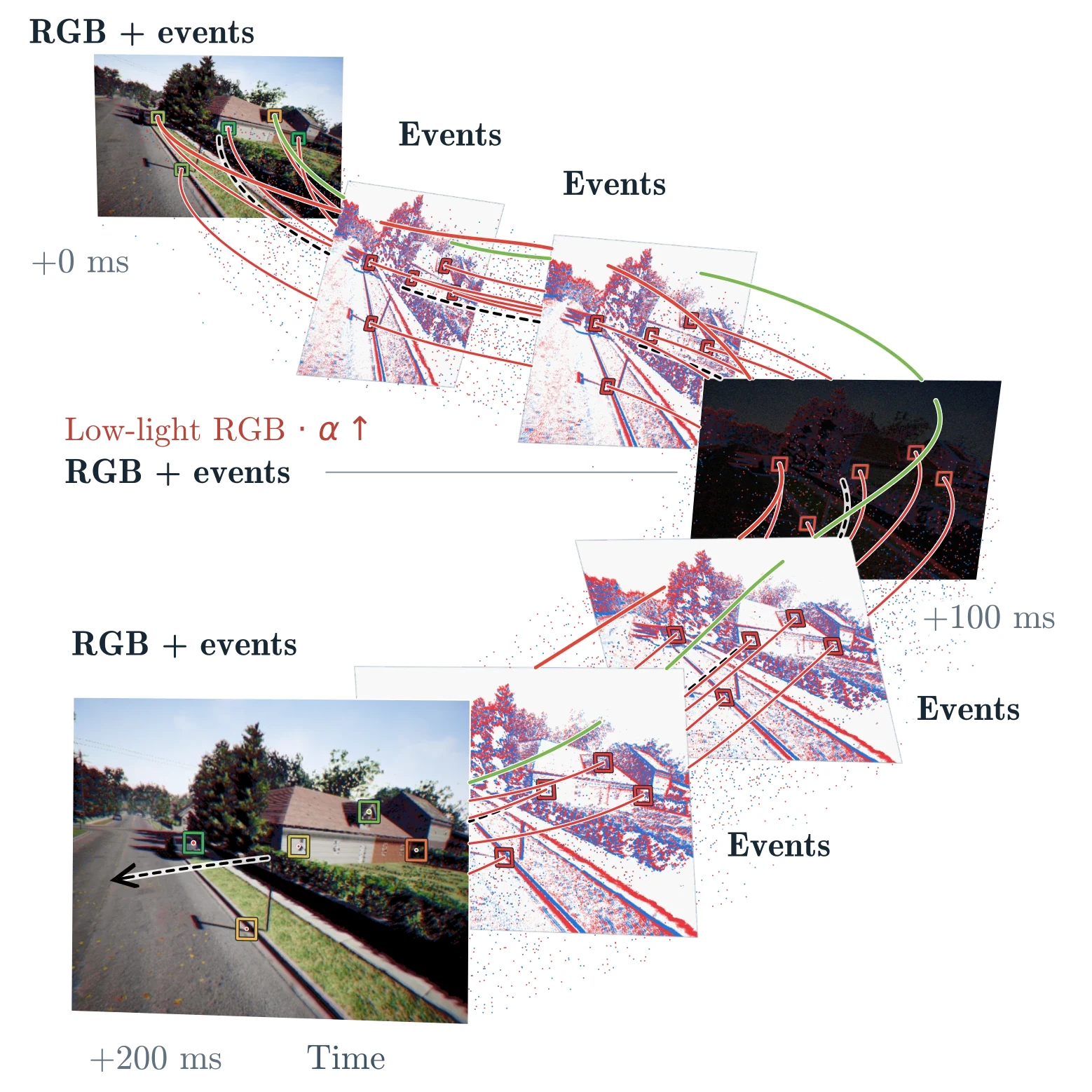

Image: Luca Gandolfi and co-authors / UZH Robotics and Perception Group

Scandit launches software to catch missed scans at self-checkouts

Scandit launched Self-Checkout Loss Prevention, software that compares camera footage with scanner and point-of-sale data to flag potential losses before checkout finishes. It detects patterns including missed scans, items left in trolleys and abandoned transactions. On-screen prompts let shoppers correct flagged items, with staff notifications available when intervention is needed.

Video processing runs locally at each checkout station. The system can reuse existing cameras and does not require a dedicated in-store server or purpose-built AI camera, although installations may need a per-station processing unit. It analyses items and transaction activity without facial recognition or biometric identification.

Self-checkout loss prevention. Image: Scandit

ETHEREAL vision chip runs event-camera inference in 25.6 microseconds

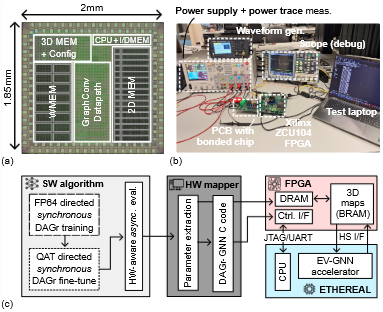
Researchers including UZH's Robotics and Perception Group demonstrated ETHEREAL, a processor designed for graph neural networks that analyse event-camera signals. Measurements on the DAGr-GNN workload and the 640-by-480-pixel DSEC dataset showed 25.6 microseconds of latency and 1.6 microjoules of energy per event-wise inference.

The chip combines parallel processing of neighbouring events with a memory design that caches relevant spatial and temporal information. It addresses the irregular memory access that makes these networks difficult to accelerate. The result is a measured research-chip demonstration, not a commercially available vision system; the August manuscript was submitted for possible journal publication.

ETHEREAL research illustration. Image: ETHEREAL authors / UZH Robotics and Perception Group.

SUIND raises INR 205M seed

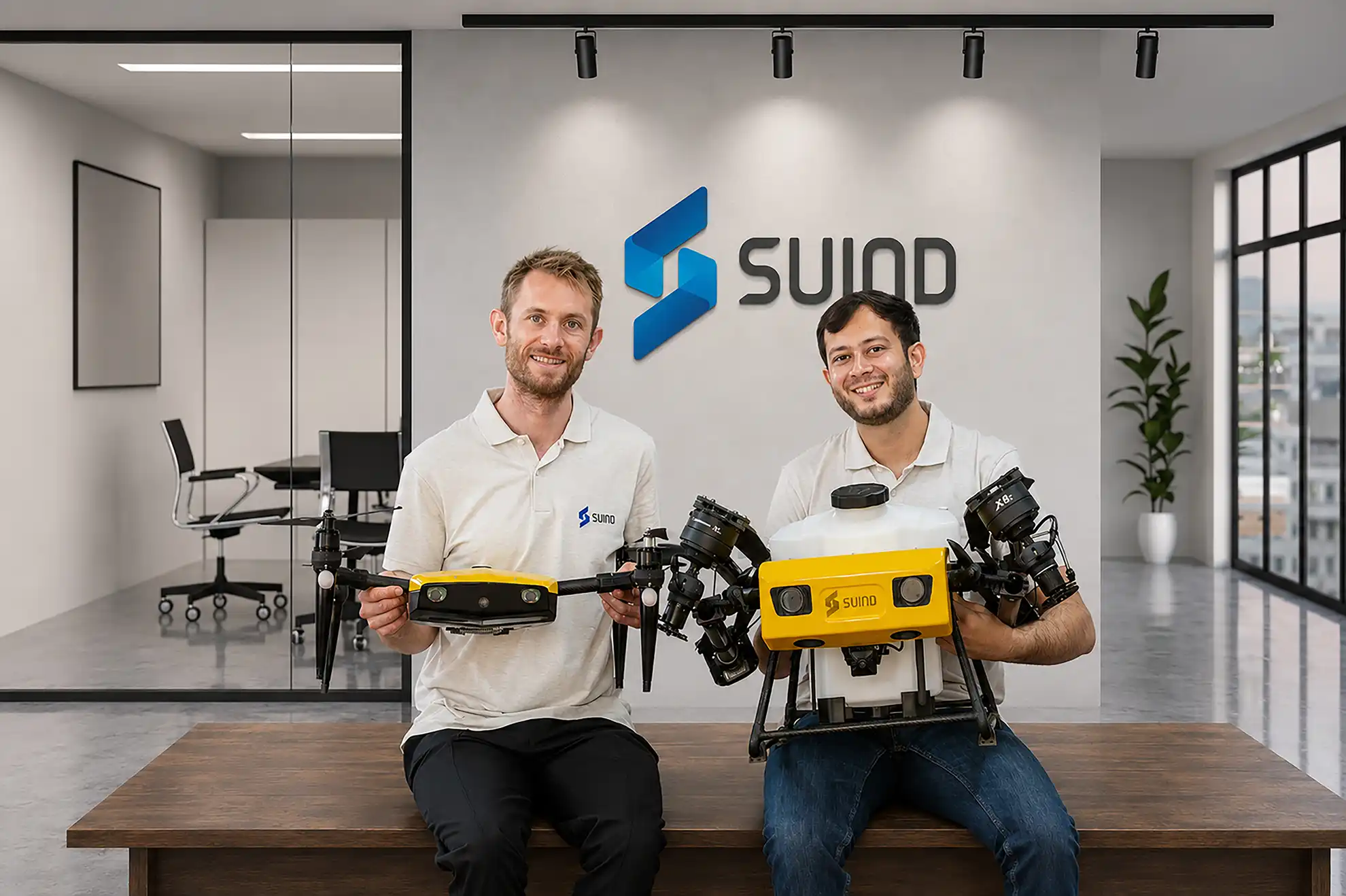
SUIND has raised INR 205 million in a seed round led by Transition VC, with participation from IIMA Ventures. Founded by ETH Zurich alumni, the company now operates primarily from Bengaluru and retains a Zurich presence. The financing will expand deployment of its Bumblebee agricultural drone and support development of WASP, an aerial inspection and monitoring platform.

Its flight technology uses computer vision to navigate close to terrain and obstacles where GPS alone is unreliable. Bumblebee is already deployed for crop spraying; WASP extends the approach to other inspection and surveillance tasks. The company plans to strengthen its engineering team and scale manufacturing and commercial deployments, with India remaining its main market.

SUIND's founders. Photo: SUIND

Sony AI's Ace robot beats seven ranked table-tennis professionals

Sony AI reported that its Ace table-tennis robot won matches against seven players with current or recent professional rankings in tests held from February to April 2026. The opponents included Miyuu Kihara and Miu Hirano. This extends the earlier Nature study, in which Ace beat elite players but had not yet outplayed professionals.

The Zurich-linked research team improved control, simulation, hardware and perception, with a single reinforcement-learning policy now handling nine skills. Sony published match-by-match results: the system won at least one match against seven of eight opponents, but lost all three against Ono. Matches followed official competition rules; several early assessments were internal, without external umpires.

Ace match highlights. Video: Sony AI

AVIAN raises USD 2.6M pre-seed

AVIAN raised USD 2.6 million in pre-seed funding led by Founderful to expand its industrial monitoring systems beyond wood-processing plants. The Zurich-area company combines infrared cameras, anomaly detection and alerts to identify overheating machinery before failures escalate.

Its cameras continuously monitor equipment such as bearings, conveyors and electrical cabinets, learning the normal temperature patterns at each site. The platform adds maintenance reports and human support, with the funding directed toward engineering and deployment capacity. AVIAN reported installations at approximately 50 sites in nine countries at the announcement.

AVIAN dashboard displaying feeds from multiple thermal cameras. Image: AVIAN

Mosaic SoC raises USD 3.8M pre-seed

Mosaic SoC raised USD 3.8 million in pre-seed funding led by Founderful, with participation from Kick Foundation. Founded by ETH Zurich researchers Alfio Di Mauro and Moritz Scherer, the company develops chips that process camera and motion-sensor inputs within the power limits of wearable and mobile devices.

Its multicore design is intended to run spatial perception locally, with software that device manufacturers can integrate into their products. The company reported engineering revenue from development partners and showed an FPGA emulation of its chip. The release describes a route toward commercial chip sales, rather than confirming mass-produced silicon.

Mosaic SoC's chip design emulated on an FPGA development board. Photo: Mosaic SoC

Stacked image sensors capture red, green and blue at each pixel

ETH Zurich and Empa researchers built two working thin-film image sensors that stack colour-sensitive perovskite layers vertically. By changing the material's chemical composition, each layer absorbs a selected part of the spectrum while passing other wavelengths onward. The arrangement lets each pixel measure red, green and blue without the side-by-side colour filters used in conventional silicon sensors.

The Nature study advanced the team's earlier single-pixel demonstrations into functioning sensor prototypes with different readout architectures. The approach promises better use of incoming light, more accurate colour reproduction and fewer demosaicing artefacts. Its theoretical threefold advantage in light collection and spatial resolution is a consequence of the stacked design. The prototypes still had pixels 0.5 to 1 millimetre across, leaving substantial lateral miniaturisation and readout development before consumer-camera applications.

One of the thin-film perovskite sensor prototypes. Image: Empa / ETH Zurich.

Event cameras and AI speed up obstacle detection

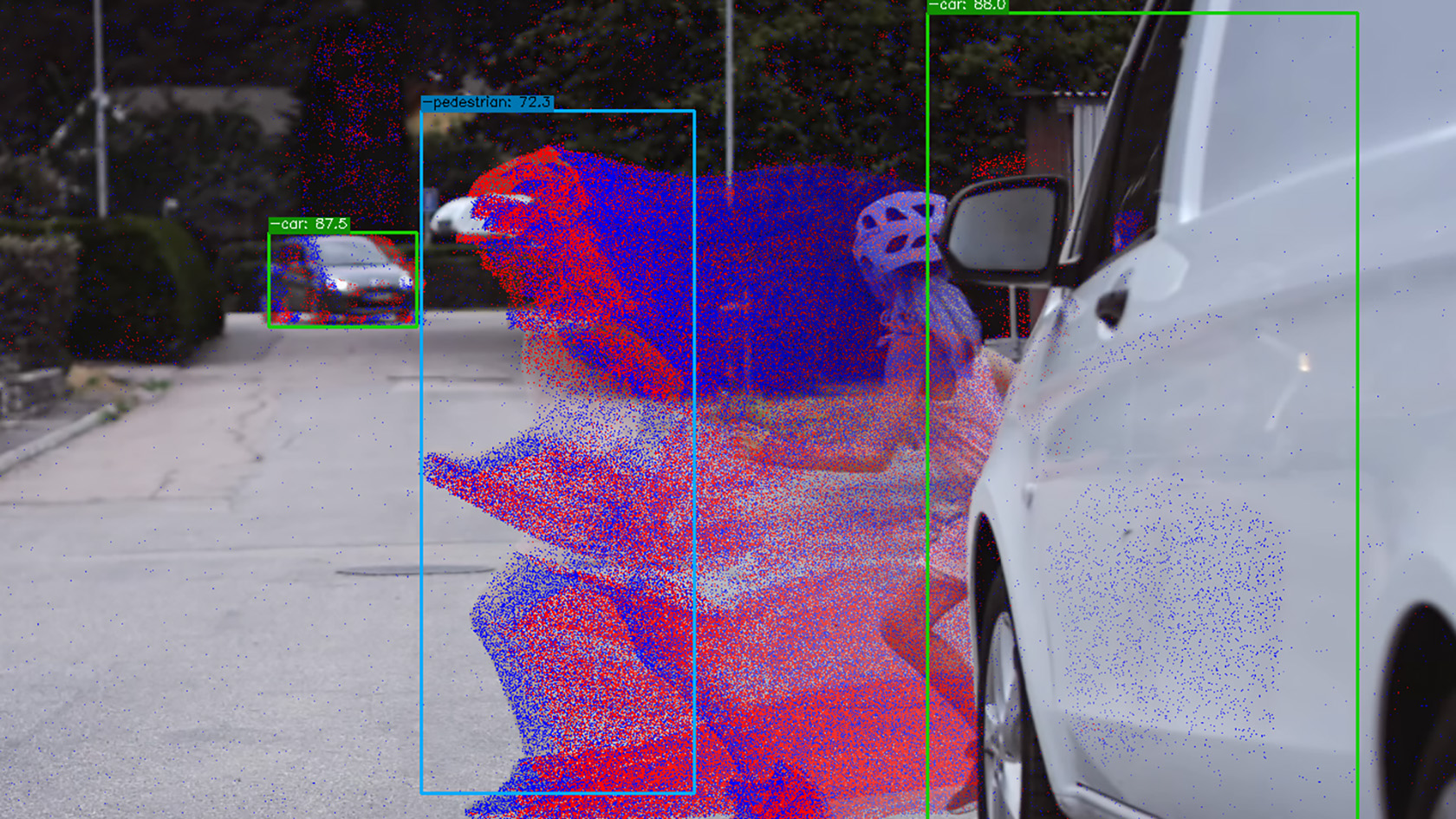
University of Zurich researchers Daniel Gehrig and Davide Scaramuzza developed a hybrid vision system that combines conventional images with the rapid brightness-change signals produced by an event camera. A convolutional neural network processes the ordinary images, while an asynchronous graph neural network analyses events to anticipate objects appearing between frames. The system was presented in a Nature study.

In the reported comparisons, the hybrid detector reduced detection latency by a factor of 100 without sacrificing accuracy. Its conventional camera operated at 20 frames per second; the combined system offered detection timing comparable to a 5,000-frame-per-second camera at the bandwidth of a conventional 50-frame-per-second camera. The research addresses the delay between capturing a scene and detecting an obstacle, a critical perception bottleneck in driver assistance and autonomous vehicles.

Conventional image and event-camera signals from a running pedestrian. Image: Robotics and Perception Group / UZH.

Autonomous excavator builds a six-metre-high dry-stone wall

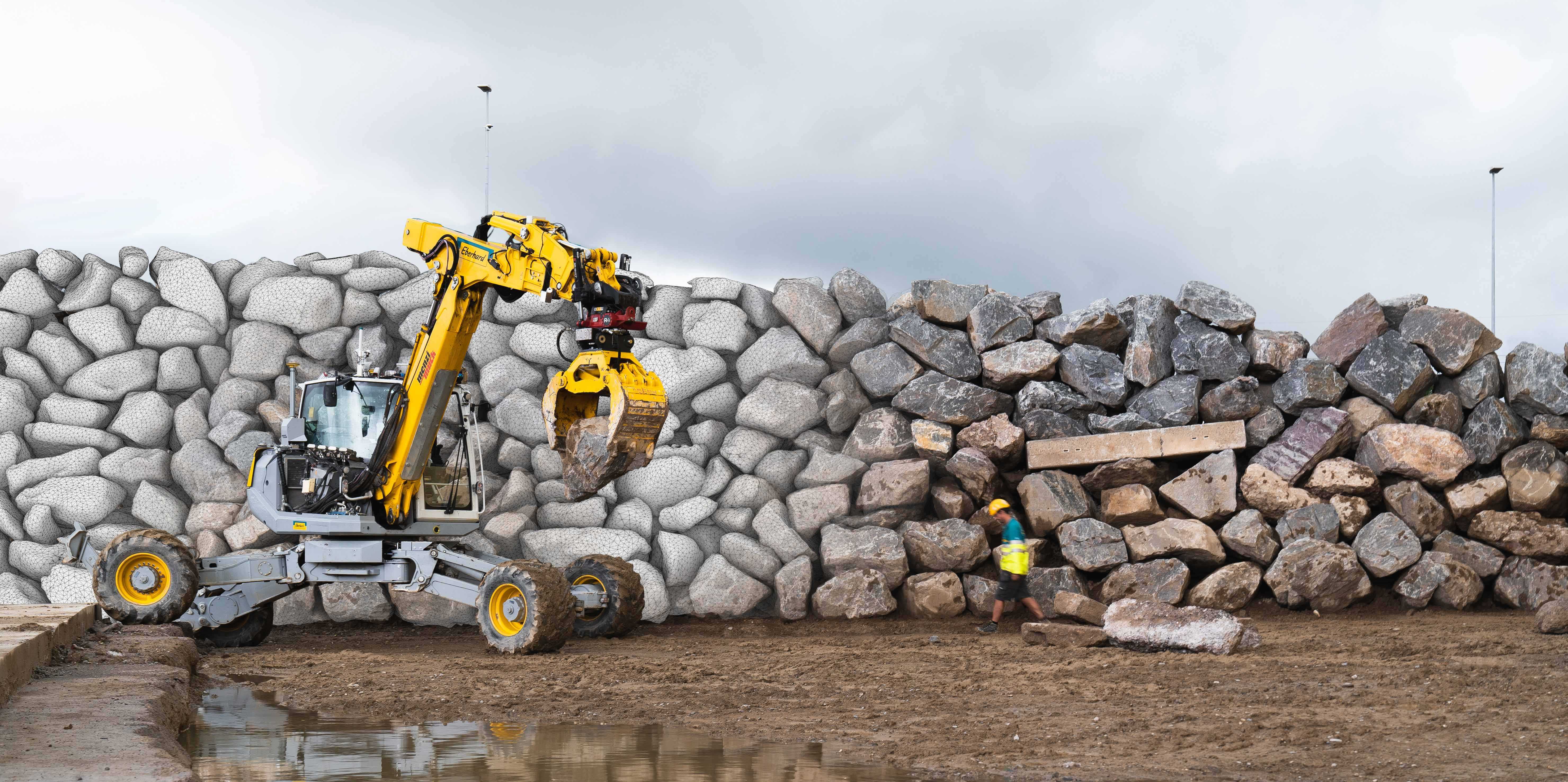
ETH Zurich researchers demonstrated an autonomous excavator constructing a dry-stone wall six metres high and 65 metres long at the Circularity Park in Oberglatt. The machine, called HEAP, used sensors to map its surroundings, scan individual stones and determine how they could fit into the structure. The field demonstration brought robotic construction research into a working material-reuse setting operated by Eberhard.

The twelve-tonne excavator estimated properties including each stone's shape and weight, then selected placements and positioned the irregular blocks without mortar. Its planning system adapted to the available material instead of requiring identical prefabricated units. The work showed how autonomous machinery could use locally available stones and demolition material in substantial structures. The field demonstration integrated sensing, planning and manipulation on a real construction site, handling the variation in shape and size of reclaimed material.

The HEAP excavator beside the dry-stone wall in Oberglatt. Photo: ETH Zurich / Marc Schneider.

Swift autonomous drone beats human racing champions

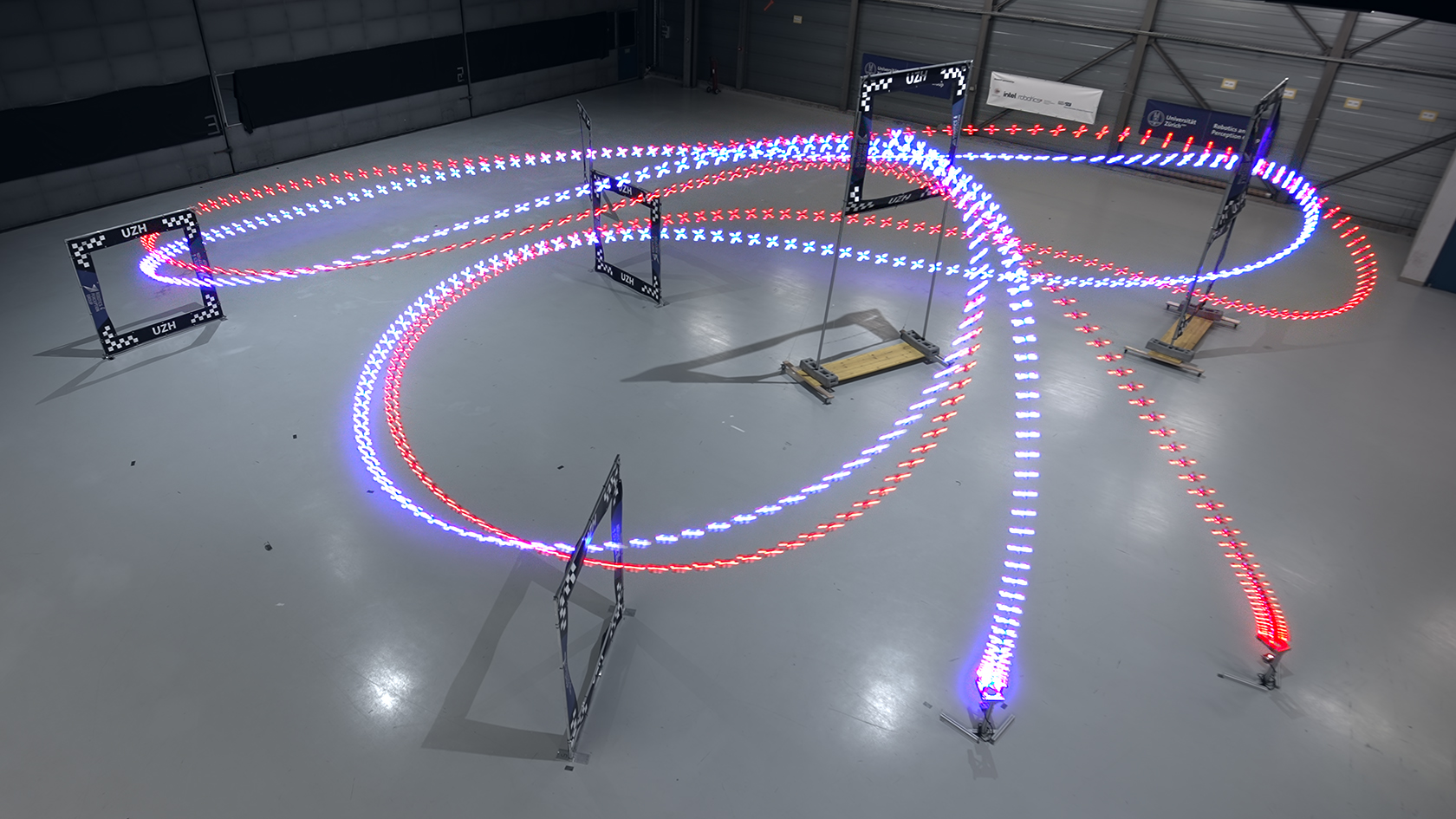
University of Zurich researchers reported that their Swift autonomous drone-racing system defeated world-champion human pilots in head-to-head races. The competition used physical quadcopters on a course at an airfield in Duebendorf. Swift combined an onboard camera and inertial measurements with a control policy trained through reinforcement learning, using simulation and real flight data to prepare for the course.

The system won multiple races against three champions and recorded the fastest lap, half a second ahead of the best human time. The races took place in June 2022; the Nature publication and public announcement followed in August 2023. The result demonstrated high-speed perception and control in a structured physical environment. The researchers also reported limitations when conditions differed from training, including changes in lighting.

Drone-racing trajectories from the Swift experiments; the autonomous system's fastest lap is shown in blue. Image: UZH / Leonard Bauersfeld.

FRAN makes faces look older or younger in video

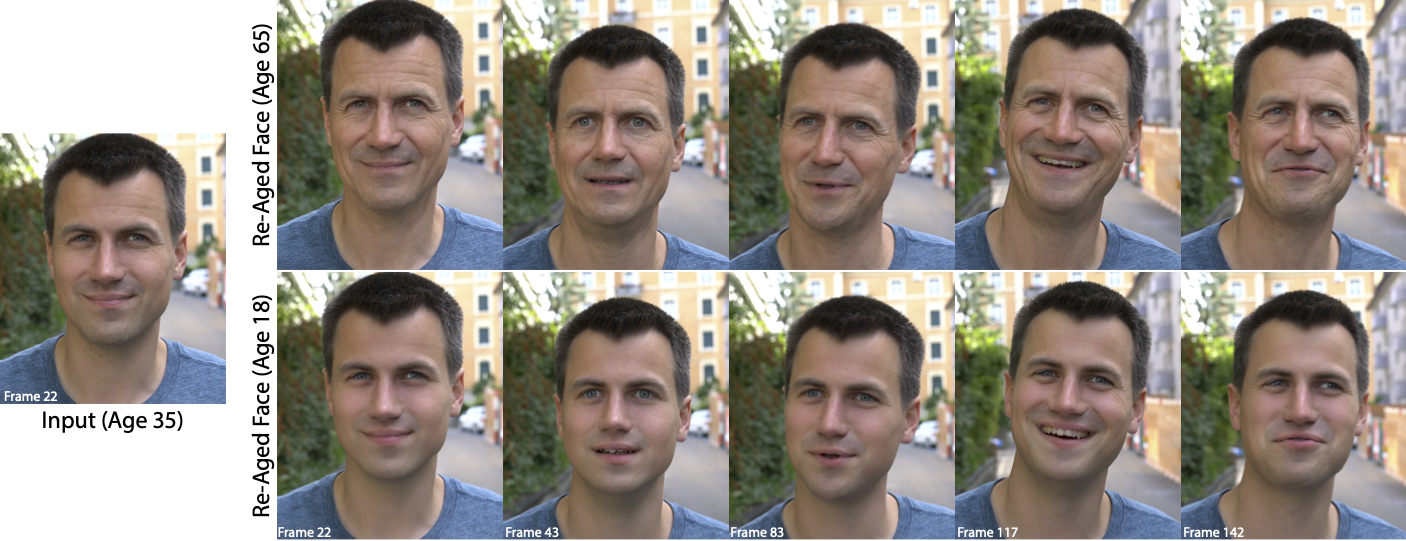
Disney Research Studios and ETH Zurich researchers presented FRAN, a neural method for changing a person's apparent age in video while preserving identity and expression. The system was trained using synthetic images of faces at different ages, addressing the difficulty of assembling real photographs of the same people across decades. Its image-to-image network applies age-related changes while retaining details needed for visual-effects work.

The research focused on consistency across video frames and robustness to variations in viewpoint, lighting and facial expression. It also provided controls for artists to adjust the effect locally rather than accepting a single automatic result for the entire face. Published as production-ready face re-aging research, FRAN gave visual-effects artists a tool for applying consistent age changes while retaining control of the final appearance.

Face re-aging examples from the FRAN research. Image: Disney Research Studios.

LatticeFlow raises USD 12M Series A

Zurich-based LatticeFlow raised USD 12 million in a Series A backed by Atlantic Bridge, OpenOcean and FPV Ventures, with existing investors also participating. The ETH Zurich spin-off develops tools to identify problems in computer vision datasets and models before those problems undermine real-world deployment. Investor btov, now b2venture, announced the financing on 26 October.

The platform addresses the gap between performance on laboratory datasets and reliability in production, where images and operating conditions can differ from training examples. Its tools automate diagnosis and correction work that otherwise requires machine learning engineers to inspect data and models manually. At the announcement, the company cited customers including Siemens Mobility and AI businesses Intenseye, Voxel AI and Carscan.

LatticeFlow photograph accompanying the investor's Series A announcement. Source: b2venture / LatticeFlow.

Scandit raises USD 150M Series D

Zurich-based Scandit raised USD 150 million in a Series D led by Warburg Pincus, taking its valuation above USD 1 billion. Existing investors also participated, including Atomico, Forestay Capital, G2 Venture Partners, GV, NGP Capital, Schneider Electric, Sony Innovation Fund and Swisscom Ventures. The round brought the company's total funding to almost USD 300 million.

Scandit's software turns cameras on smartphones and other devices into tools for reading barcodes, text and identity documents and recognizing objects. The new capital was earmarked for research and development, hiring and international expansion, particularly in Asia-Pacific. Scandit said it served more than 1,700 customers and had doubled annual recurring revenue since its previous funding round in 2020.

Scandit's founders in the company's Series D announcement. Source: Scandit.

Confirm

Install zurich.tech