Menu

News

Materials

Tags

Bacteria bind 3D-printed sand into building components

ETH Zurich researchers developed a printable mixture of sand, bacteria and natural gels to make architectural elements, including a facade component. After printing, daily mineralisation baths let the bacteria form calcium carbonate crystals that bind the sand together. The material hardens at room temperature over two to five days, without firing it in a kiln.

A second method uses a robotic arm to deposit sand, bacteria and mineralising substances in successive layers, demonstrated at the 2025 Venice Architecture Biennale. Neither approach is a ready replacement for structural concrete: load-bearing applications remain distant, and the sprayed material needs further mechanical testing. The reaction also produces environmentally harmful ammonium, so waste treatment must be addressed before claiming a sustainable alternative.

Video: Kai Hsun Yeh and Kevin Seav / ETH ZurichWatch video

UniSieve raises USD 9M Series A

Zurich-based UniSieve raised USD 9 million in Series A funding, bringing its total funding to USD 25 million. The company will use the capital to scale deployment of its gas-separation membranes and adapt them to additional industrial applications.

The membranes separate molecules through precisely sized pores, offering an alternative to energy-intensive thermal separation. UniSieve says its systems have reached pre-commercial maturity in olefin separation and carbon capture at emission sources, with field-tested performance and repeatable manufacturing supporting the move towards broader commercial deployment.

UniSieve's propylene-recovery pilot system beside petrochemical process equipment. Photo: UniSieve

OLED pixels can be patterned using chipmaking techniques

ETH Zurich researchers developed light-emitting polymers that also act as photoresists, allowing OLED materials to be patterned with chipmaking techniques. Reactive groups on the outside of each molecule cross-link under UV light, while a protective shell shields its light-emitting core from processing chemicals.

The team produced a 300 by 430 micrometre fluorescent test image and, separately, an electrically powered ETH logo measuring 1 by 2.4 millimetres. The fluorescent image is not a display, and a working screen still requires electronics to control individual pixels independently.

Microscopic fluorescent test image, 300 by 430 micrometres; not an electrically driven display. Image: Lo SW et al., Nature 2026 / ETH Zurich

Fire-resistant panels separate into fibres and cores for recycling

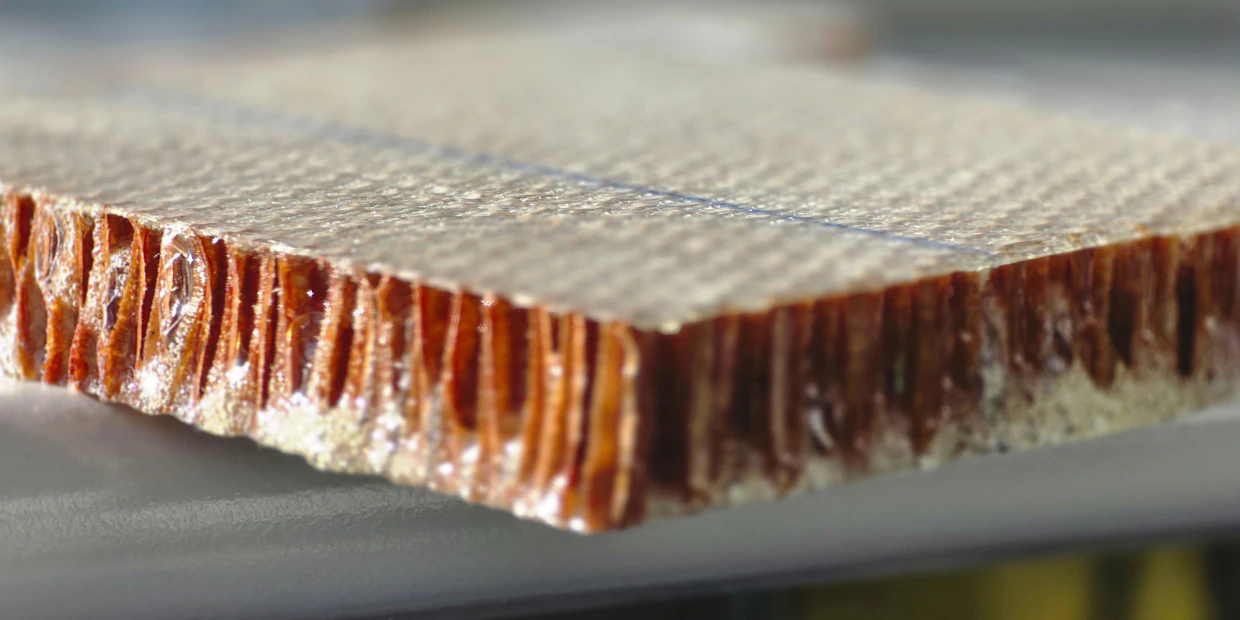
Empa and Elantas developed a flame-retardant composite for aircraft and train interiors that can be separated for recycling. A phosphorus-containing additive changes the epoxy binder, allowing solvent and heat to release the woven fibres and aramid honeycomb core from multilayer panels.

The team reports compliance with fire-safety requirements and mechanical properties close to conventional epoxy composites. Production and recycling still need to be scaled up. Recovering the epoxy resin itself from the solution remains future work, so the result should not be read as a demonstrated closed-loop recycling process for every component.

Flame-retardant epoxy and glass-fibre composite developed for recycling. Image: Empa.

Treeless raises CHF 1.2M

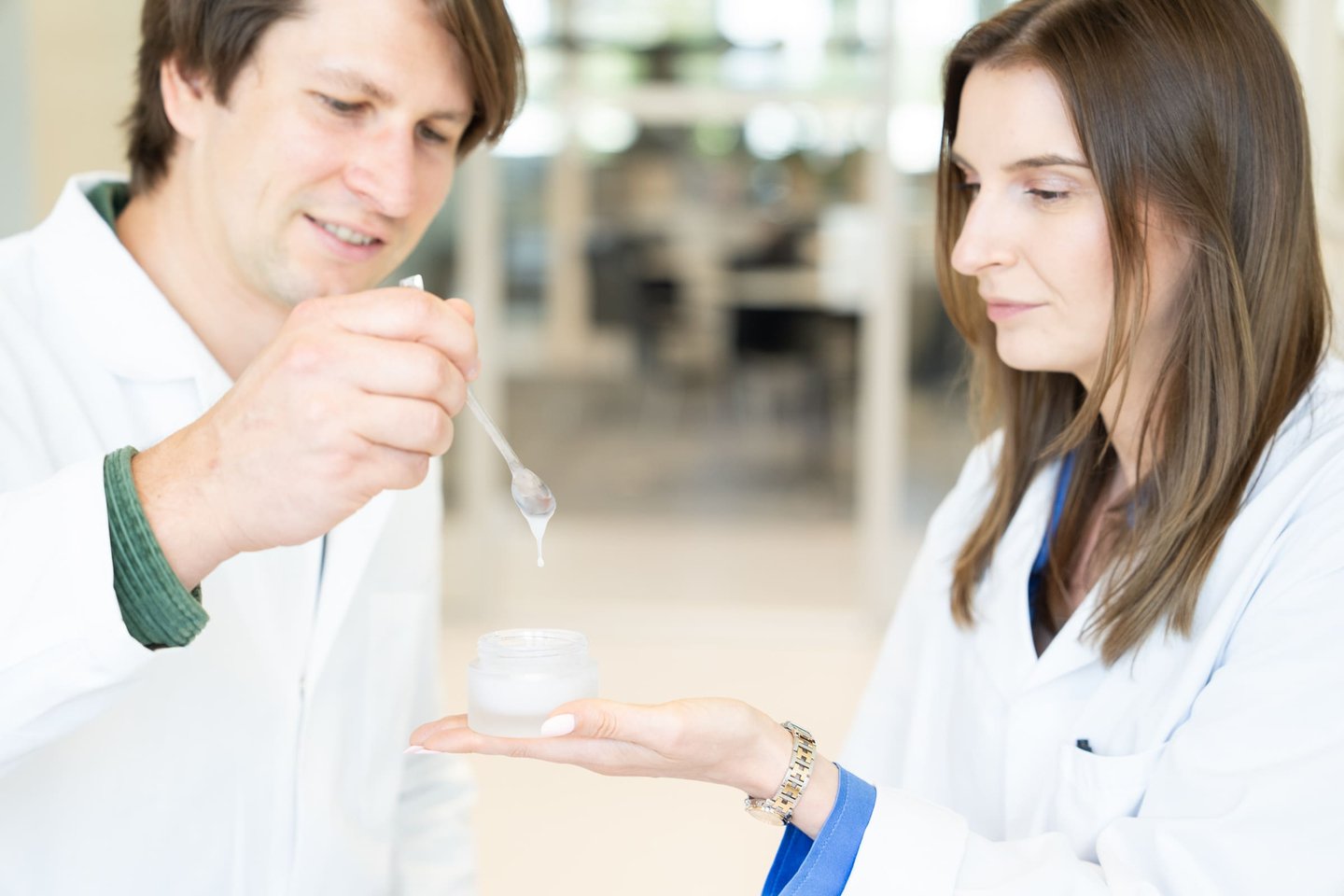
Treeless has closed an oversubscribed CHF 1.2 million financing round. The ETH Zurich spin-off, which has offices, laboratories and production facilities in Schlieren, develops materials made using microorganisms as alternatives to fossil-based ingredients.

The company will use the funding to commercialise its technology, develop its modular manufacturing platform, expand its team and strengthen industrial collaborations. Its work combines biotechnology and automated production to supply materials and formulations for industrial customers.

Examining a material sample. Photo: Treeless

Cell-compatible hydrogel can be printed at 400 millimetres per second

ETH Zurich researchers developed a light-sensitive hydrogel that can be patterned at writing speeds of up to 400 millimetres per second, with structures as small as 500 nanometres. A new crosslinking molecule allows laser pulses to solidify selected regions of a mixture containing 97 percent water, creating intricate scaffolds modelled on bone architecture.

In laboratory cell cultures, bone-forming cells colonised the printed structures and began producing collagen. The team led by Xiao-Hua Qin and Ralph Müller reported the fabrication method in Advanced Materials and patented the base material. The work remains at the in-vitro stage, with animal tests planned to examine bone formation and mechanical recovery.

Bone-forming cells in light blue, with purple nuclei, colonise the grey hydrogel scaffold. Image: Margherita Bernero / ETH Zurich.

Rotating 3D printer combines two metals in a continuous process

An ETH Zurich student team built and tested RAPTURE, a rotary laser powder-bed-fusion machine that can deposit and melt two different metals during the same operation. Developed in the Advanced Manufacturing Lab over nine months, the prototype coordinates powder supply, laser scanning and protective gas flow in a continuous process suited to roughly cylindrical components.

ETH reported that the approach reduced manufacturing time for cylindrical parts by more than two thirds. Depositing powder only where needed also reduces the mixed-material waste created by conventional multi-metal processes. The prototype produced components up to 20 centimetres in diameter, including a 75-millimetre turbine stator. Applications under investigation include rocket nozzles combining heat-conducting and heat-resistant materials. ETH filed a patent application, while higher speeds and larger component sizes remained development goals.

RAPTURE's rotary multi-material printing process. Image: Michael Tucker / ETH Zurich.

Laboratory heat trap reaches 1,050 degrees Celsius under concentrated light

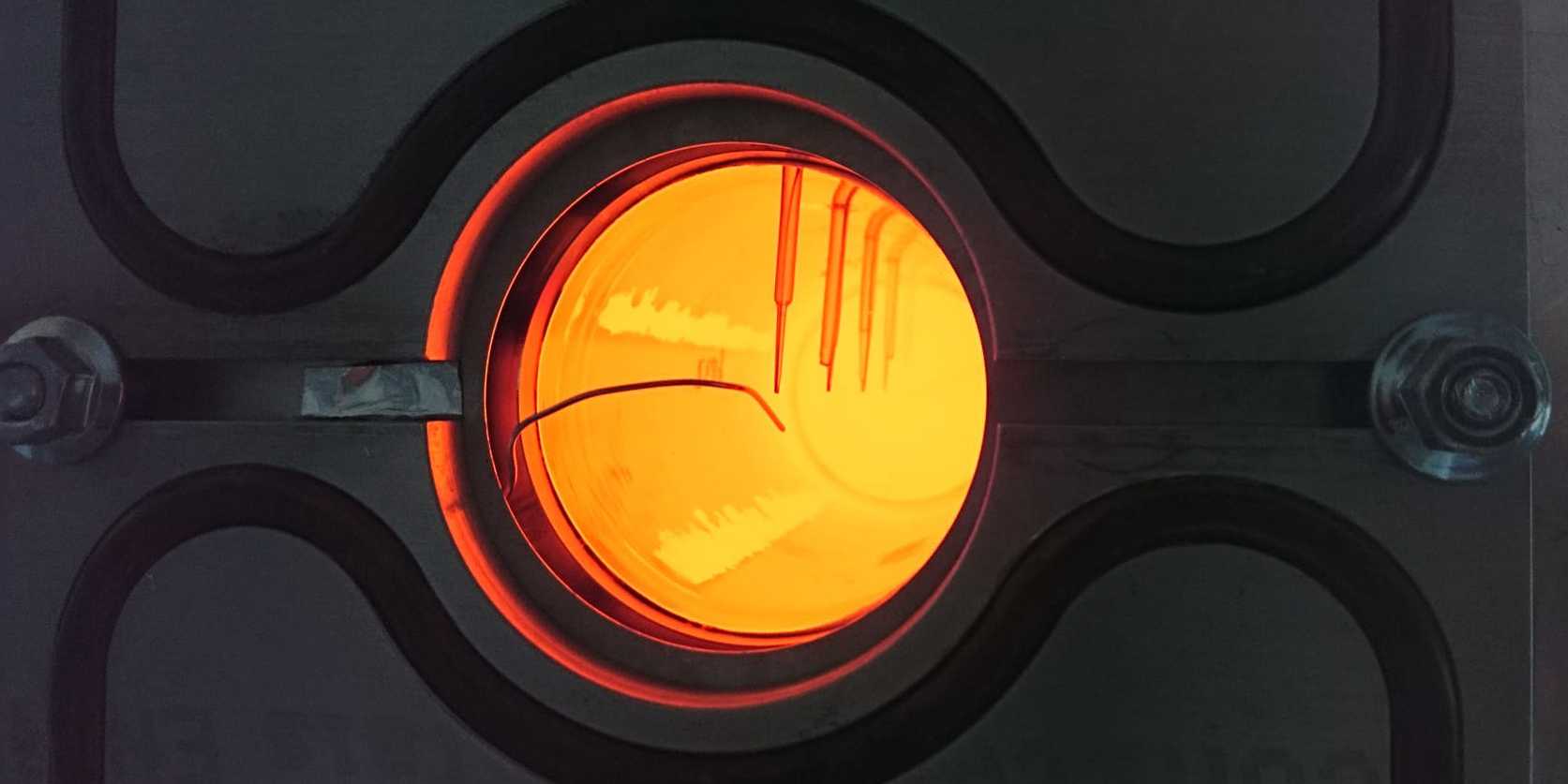
ETH Zurich researchers demonstrated a thermal trap that reached 1,050 degrees Celsius under concentrated artificial illumination. The laboratory device combined a quartz rod with a ceramic absorber: light passed through the quartz to heat the absorber, while the arrangement reduced radiative heat losses. The experiment used a rod 7.5 centimetres wide and 30 centimetres long, illuminated at an intensity equivalent to 135 suns.

The work targets process heat for industries such as cement and steel, where high temperatures are usually supplied by combustion. Published in Device, it extended thermal trapping well beyond the temperatures previously demonstrated with that approach. This was a laboratory heat-generation experiment, not an operating industrial furnace; technical and economic assessment of a scaled system remained outstanding.

Quartz thermal trap during the high-temperature experiment. Photo: Emiliano Casati / ETH Zurich.

3D-printed robotic hand combines bones, ligaments and tendons

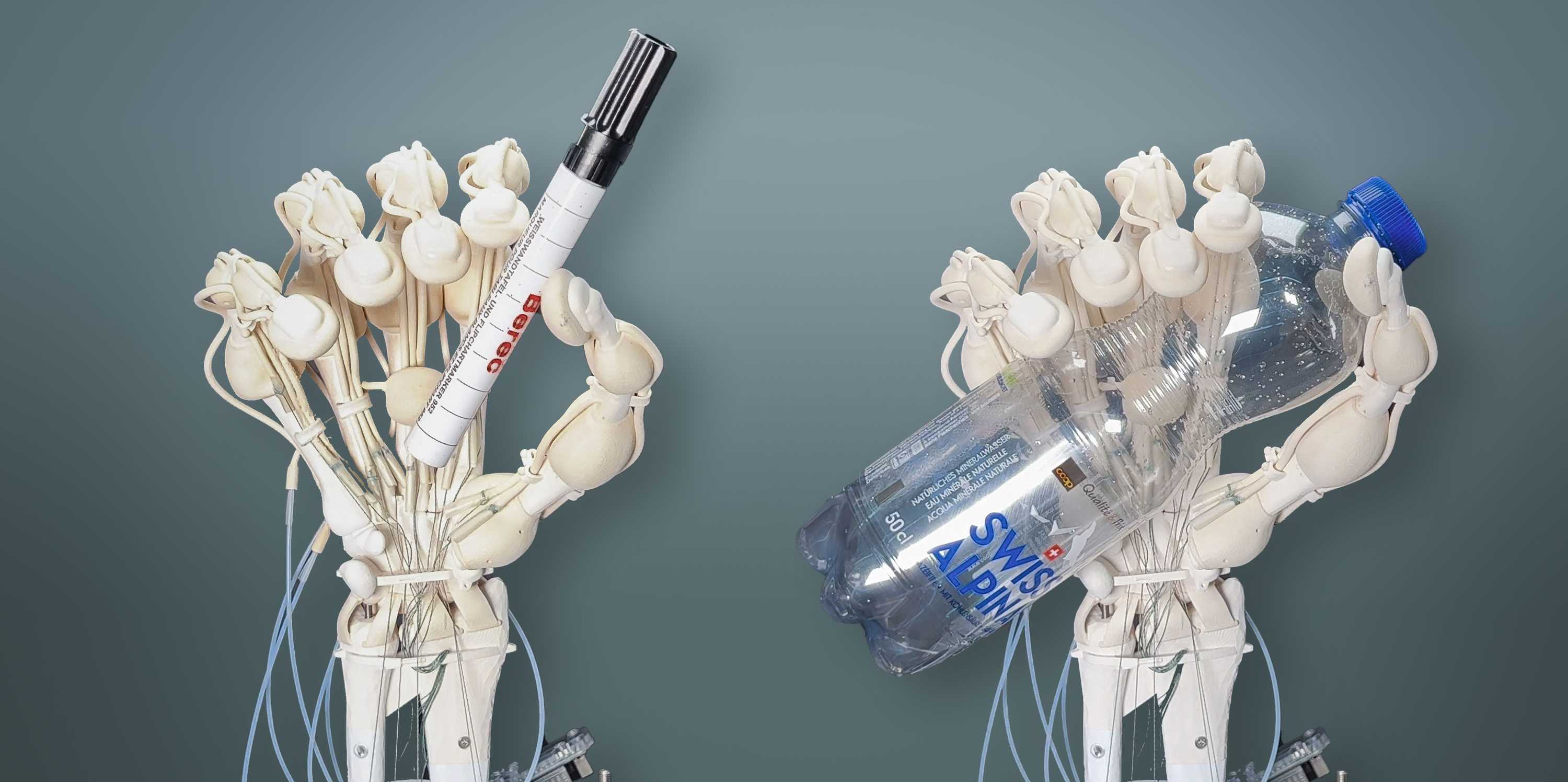
ETH Zurich researchers and US company Inkbit demonstrated a 3D-printing process that combines rigid and elastic materials in complex robotic structures. One example was a hand containing artificial bones, ligaments and tendons printed together rather than assembled from separately manufactured components. The process accommodated slow-curing polymers whose elastic properties are useful for soft robotic mechanisms.

Vision-controlled jetting scans each deposited layer and uses the measurements to adjust the next layer, compensating for irregularities without scraping the surface flat. That change allows materials that are unsuitable for conventional fast-curing inkjet processes to be incorporated. Inkbit developed the printing technology, while ETH's team developed robotic applications and helped optimise the approach. The Nature publication demonstrated how the manufacturing method could produce functional robotic structures with different mechanical properties in a single build.

Printed robotic hands combining rigid and elastic structures. Photo: ETH Zurich / Thomas Buchner.

Confirm