Menu

News

Manufacturing

Tags

Bacteria bind 3D-printed sand into building components

ETH Zurich researchers developed a printable mixture of sand, bacteria and natural gels to make architectural elements, including a facade component. After printing, daily mineralisation baths let the bacteria form calcium carbonate crystals that bind the sand together. The material hardens at room temperature over two to five days, without firing it in a kiln.

A second method uses a robotic arm to deposit sand, bacteria and mineralising substances in successive layers, demonstrated at the 2025 Venice Architecture Biennale. Neither approach is a ready replacement for structural concrete: load-bearing applications remain distant, and the sprayed material needs further mechanical testing. The reaction also produces environmentally harmful ammonium, so waste treatment must be addressed before claiming a sustainable alternative.
Video: Kai Hsun Yeh and Kevin Seav / ETH ZurichWatch video

AI predicts how metal melts during laser welding in milliseconds

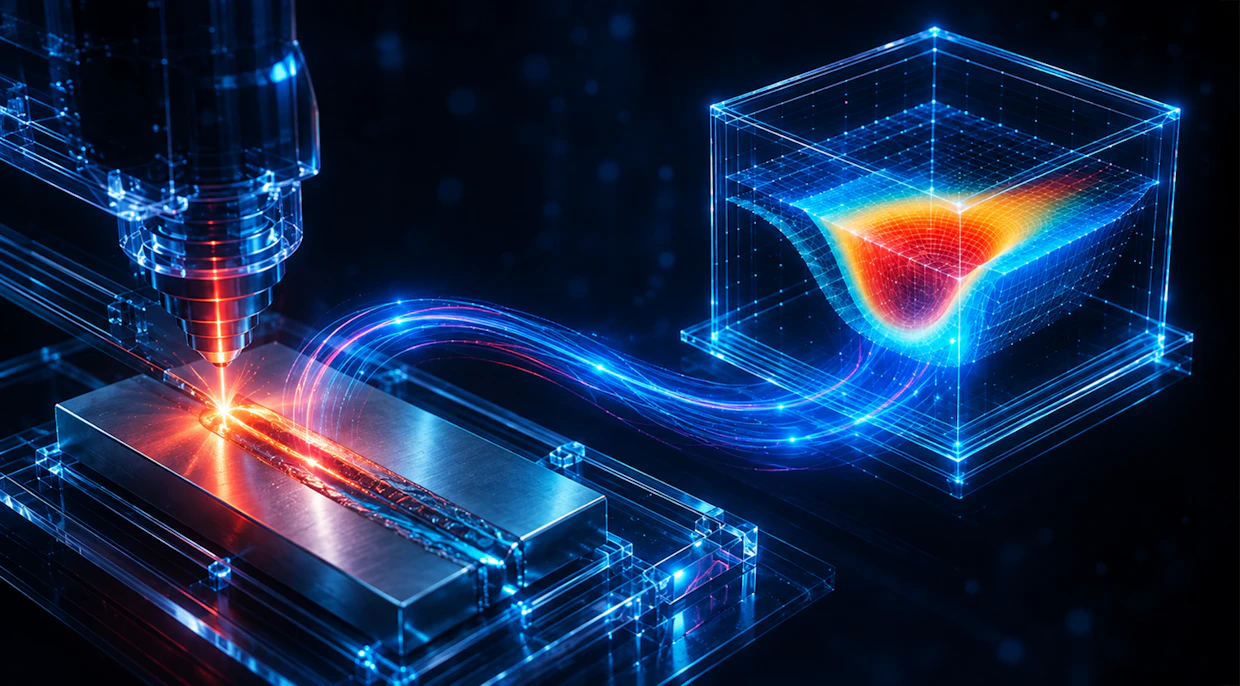
Empa and Terra Quantum developed a machine-learning model that predicts three-dimensional temperature fields and melt-pool boundaries in laser welding. After training, the Laser Processing Fourier Neural Operator produced predictions in about eight milliseconds at standard resolution and 88 milliseconds at twice that resolution, replacing physics simulations that took minutes or more than an hour.

The model learns how laser power and scanning speed affect the heated metal. Its formulation follows the moving laser and averages over time, making it useful for stable welding conditions. Strongly transient effects, including pore formation and collapsing vapour cavities, remain unresolved; real-time factory control is a prospective application rather than a demonstrated deployment.

Laser welding combines heat transfer, molten-metal flow and vapour cavities. Image: Empa.

Fire-resistant panels separate into fibres and cores for recycling

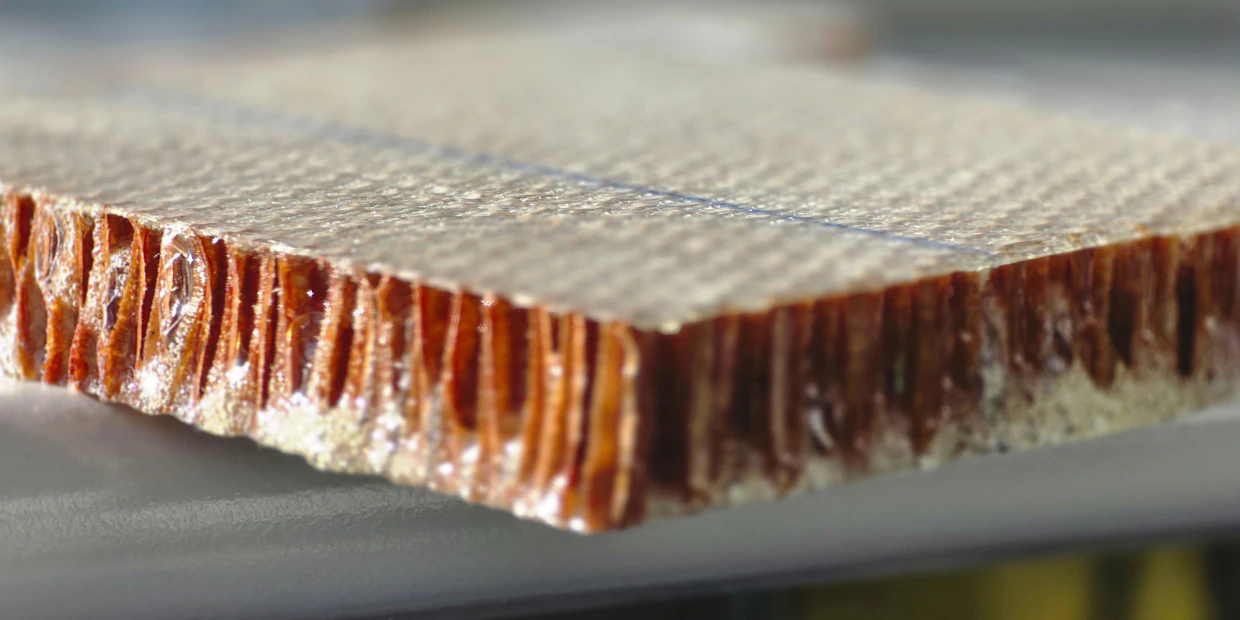
Empa and Elantas developed a flame-retardant composite for aircraft and train interiors that can be separated for recycling. A phosphorus-containing additive changes the epoxy binder, allowing solvent and heat to release the woven fibres and aramid honeycomb core from multilayer panels.

The team reports compliance with fire-safety requirements and mechanical properties close to conventional epoxy composites. Production and recycling still need to be scaled up. Recovering the epoxy resin itself from the solution remains future work, so the result should not be read as a demonstrated closed-loop recycling process for every component.

Flame-retardant epoxy and glass-fibre composite developed for recycling. Image: Empa.

AI evaluates race-car aerodynamics in seconds instead of hours

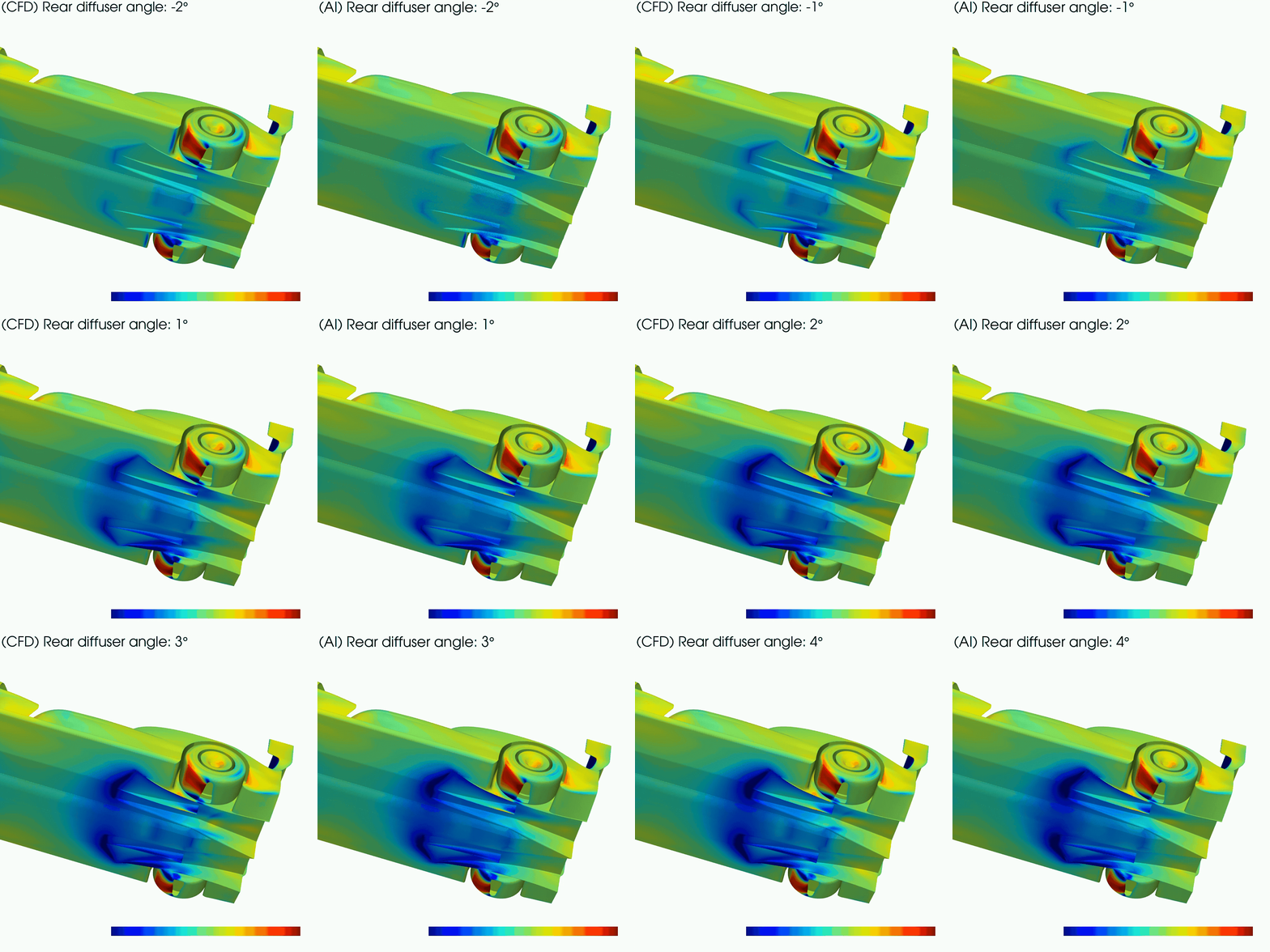
IBM researchers working with Dallara have demonstrated a machine-learning model that evaluates race-car diffuser designs in about ten seconds, compared with several hours for conventional computational fluid dynamics. In a comparison using an LMP2-like car, both approaches selected the same optimal design. The model learned from Dallara's engineering-validated simulations and was tested on held-out examples.

The Gauge-Invariant Spectral Transformer, or GIST, uses both mesh coordinates and their connections to represent detailed aerodynamic surfaces. The work includes Cristiano Malossi's team at IBM Research Zurich. These are preliminary simulation results for design screening; performance on unfamiliar vehicles still needs validation. Quantum computing is a proposed future direction, not part of the demonstrated acceleration.

Simulated pressure fields for different rear-diffuser angles: conventional CFD on the left and IBM's GIST model on the right. Animation: IBM and Dallara.

Cell-compatible hydrogel can be printed at 400 millimetres per second

ETH Zurich researchers developed a light-sensitive hydrogel that can be patterned at writing speeds of up to 400 millimetres per second, with structures as small as 500 nanometres. A new crosslinking molecule allows laser pulses to solidify selected regions of a mixture containing 97 percent water, creating intricate scaffolds modelled on bone architecture.

In laboratory cell cultures, bone-forming cells colonised the printed structures and began producing collagen. The team led by Xiao-Hua Qin and Ralph Müller reported the fabrication method in Advanced Materials and patented the base material. The work remains at the in-vitro stage, with animal tests planned to examine bone formation and mechanical recovery.

Bone-forming cells in light blue, with purple nuclei, colonise the grey hydrogel scaffold. Image: Margherita Bernero / ETH Zurich.

Chiral raises USD 12M seed

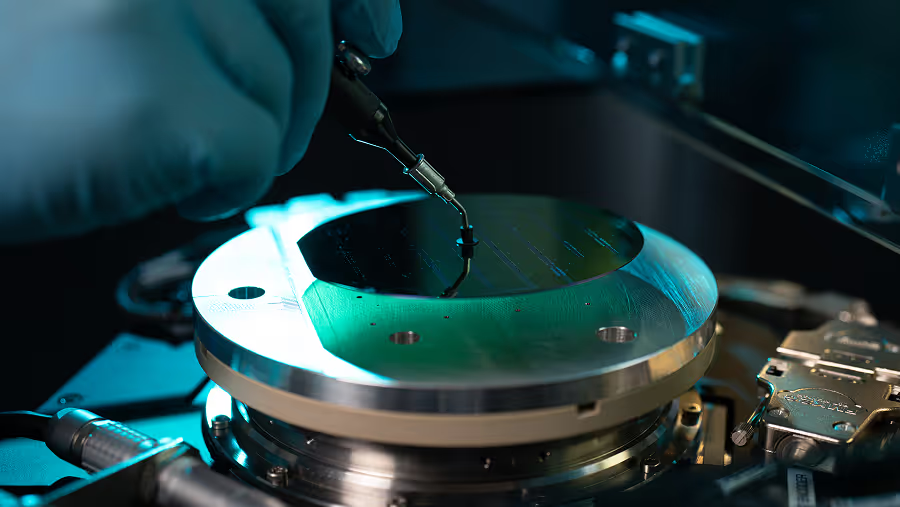
Chiral announced USD 12 million in seed financing led by Crane Venture Partners, with Quantonation, HCVC and Founderful participating, alongside public funding from Innosuisse. The ETH Zurich and Empa spin-off is developing equipment to integrate nanomaterials into semiconductor devices at wafer scale.

Its robotic system combines precision positioning, automation and process control to place materials such as carbon nanotubes onto silicon wafers. The funding will support improvements in throughput and reliability as Chiral installs its first commercial systems at customer sites.

Semiconductor equipment. Image: Chiral

Rotating 3D printer combines two metals in a continuous process

An ETH Zurich student team built and tested RAPTURE, a rotary laser powder-bed-fusion machine that can deposit and melt two different metals during the same operation. Developed in the Advanced Manufacturing Lab over nine months, the prototype coordinates powder supply, laser scanning and protective gas flow in a continuous process suited to roughly cylindrical components.

ETH reported that the approach reduced manufacturing time for cylindrical parts by more than two thirds. Depositing powder only where needed also reduces the mixed-material waste created by conventional multi-metal processes. The prototype produced components up to 20 centimetres in diameter, including a 75-millimetre turbine stator. Applications under investigation include rocket nozzles combining heat-conducting and heat-resistant materials. ETH filed a patent application, while higher speeds and larger component sizes remained development goals.

RAPTURE's rotary multi-material printing process. Image: Michael Tucker / ETH Zurich.

Manukai announces USD 3M pre-seed financing

Zurich-based Manukai announced USD 3 million in pre-seed financing to develop AI software for CNC programming. The ETH spin-off named QBIT Capital, Bloomhaus Ventures, business angels and the Innosuisse Startup Innovation Project as supporters, without disclosing the split between private investment and project support.

Manukai's software drew on manufacturers' historical production data to help programmers reuse machining knowledge within existing workflows. Its on-premises approach kept production information inside customers' own environments. The financing supported further product development and market entry, targeting manual programming work and the difficulty of transferring experienced machinists' knowledge to new jobs.

Manukai's pre-seed financing announcement. Image: Manukai.

Autonomous excavator builds a six-metre-high dry-stone wall

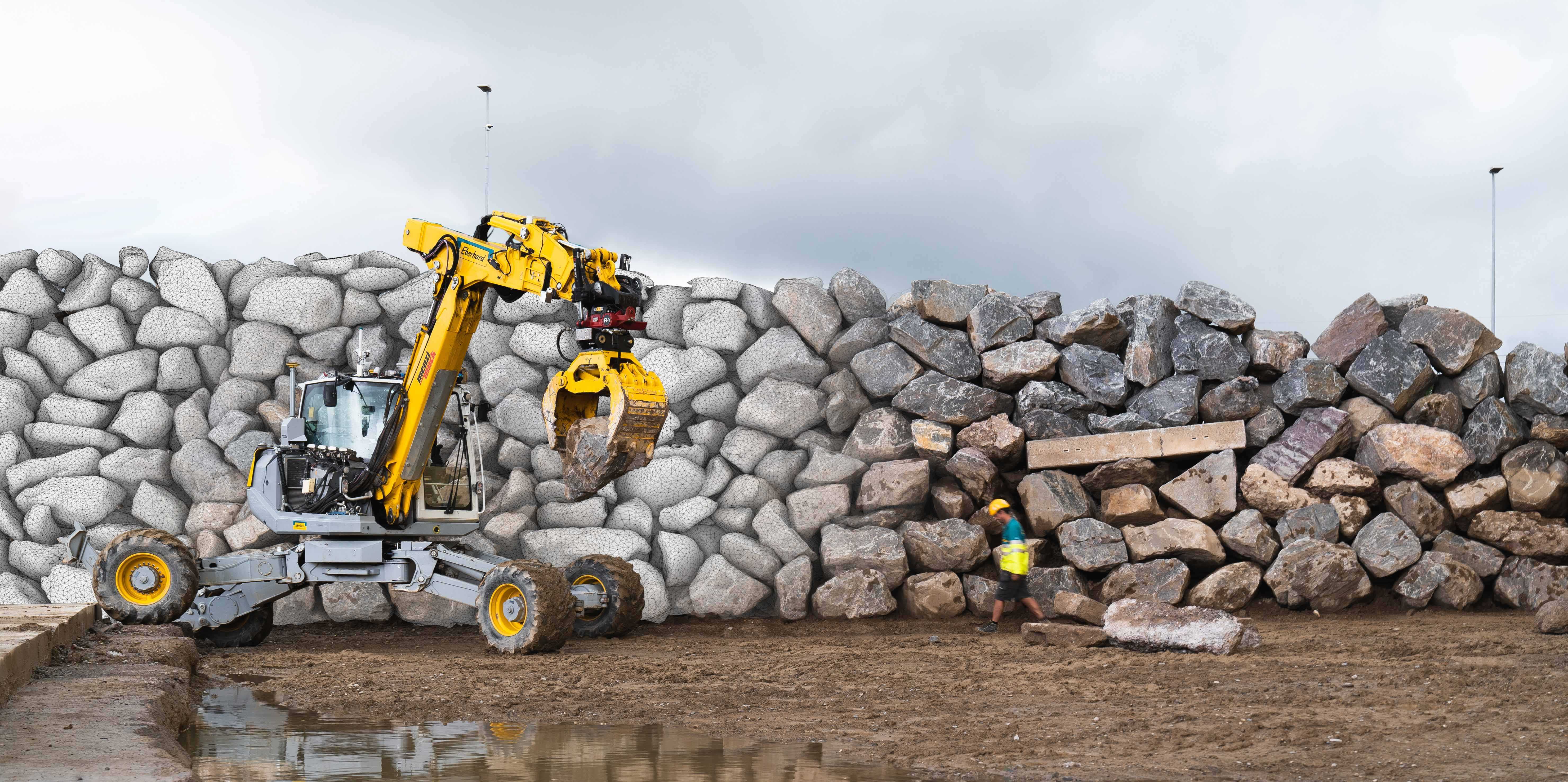
ETH Zurich researchers demonstrated an autonomous excavator constructing a dry-stone wall six metres high and 65 metres long at the Circularity Park in Oberglatt. The machine, called HEAP, used sensors to map its surroundings, scan individual stones and determine how they could fit into the structure. The field demonstration brought robotic construction research into a working material-reuse setting operated by Eberhard.

The twelve-tonne excavator estimated properties including each stone's shape and weight, then selected placements and positioned the irregular blocks without mortar. Its planning system adapted to the available material instead of requiring identical prefabricated units. The work showed how autonomous machinery could use locally available stones and demolition material in substantial structures. The field demonstration integrated sensing, planning and manipulation on a real construction site, handling the variation in shape and size of reclaimed material.

The HEAP excavator beside the dry-stone wall in Oberglatt. Photo: ETH Zurich / Marc Schneider.

3D-printed robotic hand combines bones, ligaments and tendons

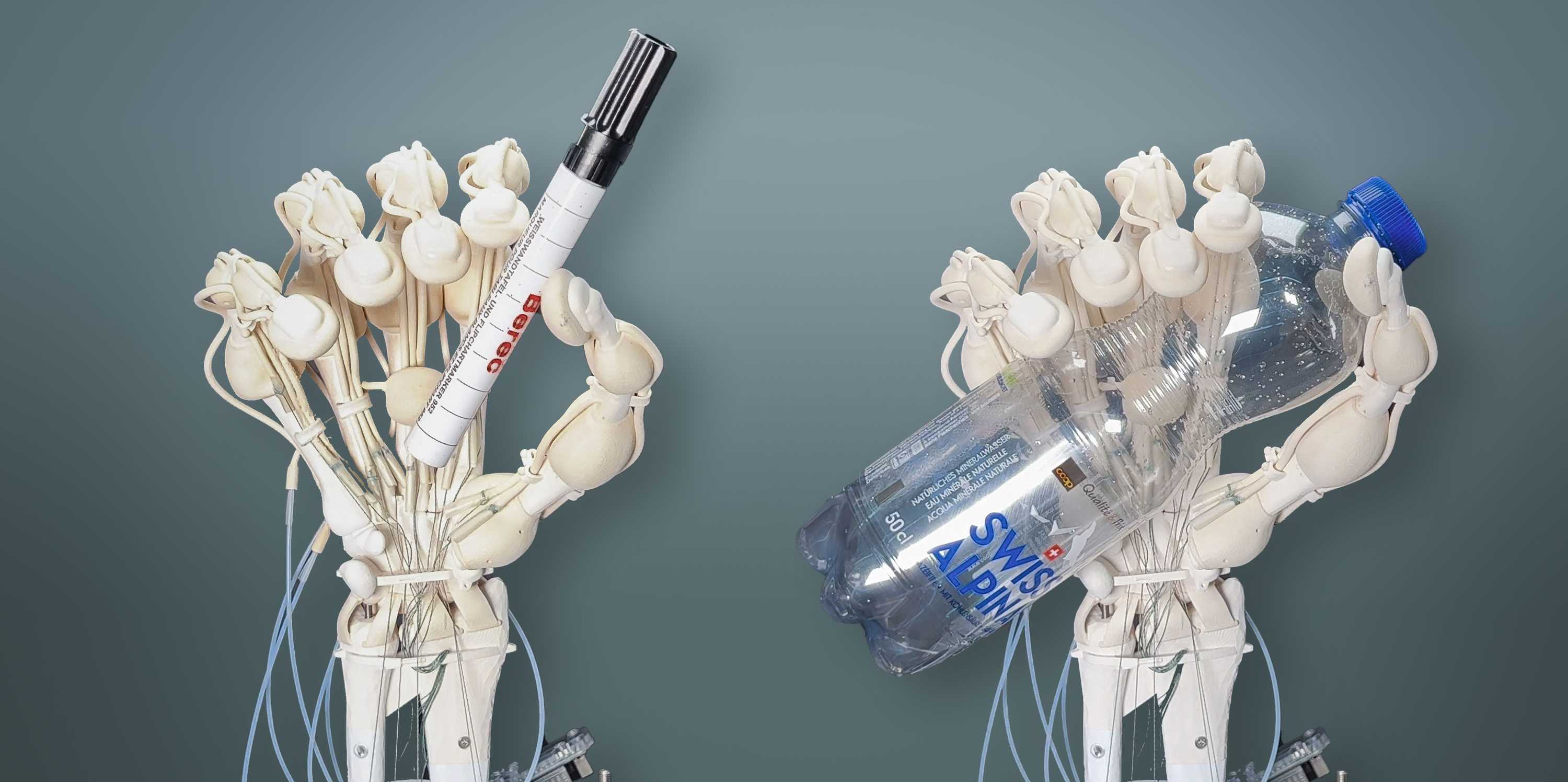
ETH Zurich researchers and US company Inkbit demonstrated a 3D-printing process that combines rigid and elastic materials in complex robotic structures. One example was a hand containing artificial bones, ligaments and tendons printed together rather than assembled from separately manufactured components. The process accommodated slow-curing polymers whose elastic properties are useful for soft robotic mechanisms.

Vision-controlled jetting scans each deposited layer and uses the measurements to adjust the next layer, compensating for irregularities without scraping the surface flat. That change allows materials that are unsuitable for conventional fast-curing inkjet processes to be incorporated. Inkbit developed the printing technology, while ETH's team developed robotic applications and helped optimise the approach. The Nature publication demonstrated how the manufacturing method could produce functional robotic structures with different mechanical properties in a single build.

Printed robotic hands combining rigid and elastic structures. Photo: ETH Zurich / Thomas Buchner.

EthonAI raises CHF 6.27M seed

EthonAI raised CHF 6.27 million in seed funding led by Earlybird Venture Capital and La Famiglia, with existing investors Wingman Ventures and Acequia Capital participating. The ETH Zurich spin-off planned to bring its quality-management software to more manufacturers and develop additional capabilities, including simulation based on causal machine learning.

The platform combined production and quality data to detect defects, monitor processes and investigate the causes of quality problems. Its visual-inspection tools highlighted suspected defects for human inspectors, while its analytics helped engineers examine factors such as temperature, tool pressure and vibration. The software was designed for process engineers and quality managers without programming expertise. Customers named at the announcement included Siemens, Roche and Lindt & Spruengli.

The EthonAI team in ETH Zurich's report on the seed financing. Photo: ETH Zurich / EthonAI.

Planted raises CHF 70M Series B

Kemptthal-based Planted closed a CHF 70 million Series B led by L Catterton, with Tengelmann Ventures joining as a new investor. Existing backers also participated, including Vorwerk Ventures, Gullspang Re:food, Movendo, Be8 Ventures, ACE and the ETH Foundation. The financing supported international expansion and a larger production footprint for the Swiss plant-based food company.

Planted planned to develop a new generation of whole-cut products, combining protein structuring with fermentation to reproduce more complex meat textures. It also intended to build a new factory to add production capacity. The work extended its established product range and manufacturing operation in Kemptthal, with the aim of reaching more customers in existing and new markets.

Planted products pictured in the Series B announcement. Source: Planted.

Scrona secures USD 6.7M Series A and USD 2.9M grant

Zurich-based Scrona announced USD 6.7 million in Series A investment and a separate USD 2.9 million grant from Switzerland's State Secretariat for Education, Research and Innovation. AM Ventures led the investment round, joined by TRUMPF Venture, Verve Ventures and Manz GmbH Management Consulting and Investment. Together, the two sources provided USD 9.6 million to industrialize and commercialize its printing technology.

The ETH Zurich spin-off develops electrostatic printheads that pull tiny droplets from a nozzle using an electric field. Its multi-nozzle approach aims to combine submicrometer printing precision with parallel production, including materials too viscous for conventional inkjet systems. Scrona planned to develop applications in semiconductor manufacturing, displays, electronics and printed circuit boards, including finely patterned layers for micro-LED displays.

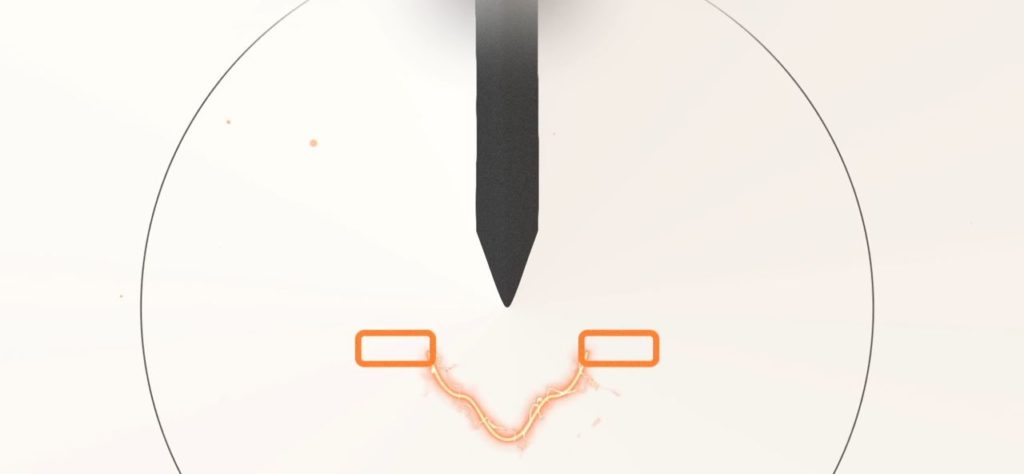
Illustration of electrostatic material ejection in Scrona's printing process. Credit: Scrona, via Fabbaloo.

Confirm